

Lived-in homes vs. catalog homes: Which one is more you?
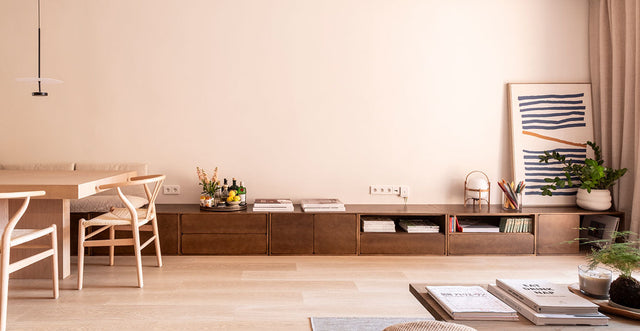
Lived-in homes vs. catalog homes: which one is more you?
You open Instagram, and all homes look the same: gray sofa, perfectly placed beige cushions, an unlit candle, and not a single trace of real life. It's pretty, yes. But you close the app and look at your living room with a touch of guilt, as if your stacked books or that inherited armchair were a mistake.

A lived-in home is one that reflects who you truly are: your well-read books, your favorite materials, the pieces you’ve carefully chosen. In 2026, the dominant trend in interior design moves away from catalog perfection: according to Pinterest's Global Design Trends report, searches for "authentic decor" grew 78% between 2024 and 2025, and 63% of users prefer interiors with their own character rather than replicated aesthetics.
What gives an interior real personality
An interior with personality combines pieces from different eras, natural textures, and objects with history. It doesn't rely on following a specific trend, but on applying coherent criteria: according to neuro-architecture studies from Aalto University (2023), homes with personal elements reduce perceived stress by up to 27% compared to uniform and neutral spaces.
Think of that bookshelf where the stories you read as a child coexist with a ceramic bought on a trip to Portugal and a plant you've managed to keep alive for three years. That mix doesn't appear in any catalog, yet it tells your story better than any render. The interesting thing is that the base can be simple and Nordic—clean lines, light wood, soft tones—and still vibrate with character. At Slowdeco, a Nordic furniture store in Valencia, proprietary collections like Penxat (solid oak modular shelving) or Liure are designed precisely for this: to offer a structured canvas that you fill with your life.
The problem with clonal aesthetics: why it gets tiresome
Catalog decor replicates a closed formula where each object serves the same aesthetic function in thousands of homes. An analysis by Houzz Spain (2024) revealed that 41% of homeowners who copied a social media image felt dissatisfied with the result within 12 months, compared to 14% who chose pieces based on their own criteria.
This weariness has a sensory explanation: when everything is too coordinated—the same color palette, the same matte finish, zero visual friction—the brain stops paying attention. It's like a song without nuances. In contrast, a Feydom modular sofa with a washed linen cover next to a Teulat dark walnut table creates a dialogue of textures that awakens the eye. The calculated imperfection—a thick wool blanket draped over the armrest, an asymmetrical stoneware vase—is what transforms a beautiful room into a place you want to return to.
How to build a lived-in home without falling into chaos
Decorating with authenticity doesn't mean giving up order or good design. The key is to start with a quality functional base and add personal layers. Interior designers like Ilse Crawford recommend the 70/30 rule: 70% timeless and well-designed pieces, and 30% objects with emotional value or unique finds.
- Choose essential furniture made with noble materials: A solid oak sideboard or an ash table lasts more than 25 years and ages gracefully. Look for oil or water-based finishes that allow the wood to breathe.
- Mix eras fearlessly: A 1960s chair next to a contemporary Penxat modular shelf creates contrast and depth. The key is to maintain a palette of no more than 3-4 main tones.
- Incorporate textured textiles: Washed linen, organic cotton, bouclé wool. These are the elements that provide immediate warmth and can be changed with the seasons for between €30 and €120.
- Leave room for imperfection: A wall with your children's framed drawings, a collection of vintage coffee makers, the uneven spines of your books. These details are irreplaceable and, therefore, authentically yours.
- Don't fill everything at once: The most interesting homes are built over time. Visit a showroom like slowdeco.es in Valencia (Avda. Pérez Galdós 127), touch the materials, sit on the sofas, and decide at your leisure.
In summary
- Authentic decor dominates 2026: searches for interiors with personality grew 78% in the last year, while the clonal aesthetic of Instagram causes dissatisfaction in 41% of those who copy it.
- The 70/30 rule works: 70% quality timeless furniture and 30% personal pieces create homes with character without falling into disorder.
- Noble materials are the base: solid woods like oak or ash, natural textiles like linen and wool, and finishes that age well for over 25 years provide solidity to any personal style.
- Slowdeco as a starting point: in their showroom in Valencia and at slowdeco.es, you can find Nordic collections like Penxat or Liure, designed to be the structure upon which to build your home, not a copy of anyone else's.
Frequently asked questions
How do I start decorating with personality if my house already has generic furniture?
You don't need to change everything. Start by replacing 1 or 2 key pieces—the sofa or the main bookshelf—with furniture made from natural materials with timeless lines. Then add personal layers: textiles, art, objects with history. In 6 to 12 months, you'll have a completely different space without major renovations or investments.
Does authentic decor mean spending more?
Not necessarily. A solid oak piece of furniture costing €800-€1,200 lasts over 25 years; a cheap particleboard piece might need replacing every 5-7 years. In the long run, investing in fewer but higher-quality pieces proves 30% to 40% more economical than constantly redecorating.
Isn't Nordic style also a repeated aesthetic?
Nordic as a closed formula can be. But Scandinavian design, properly understood, is a philosophy of functionality, honest materials, and light, not a fixed catalog. Precisely because of its sobriety, it's the best canvas for adding your personality: an inherited piece, an unexpected color, or a collection that only you have will shine brighter against a clean background.
Alicia Martínez
Interior Designer and Founder of Slowdeco
0 Comments
There are no comments for this article. Be the first one to leave a message!