
Solid wood vs. microcement: which will your living room choose in 2026?
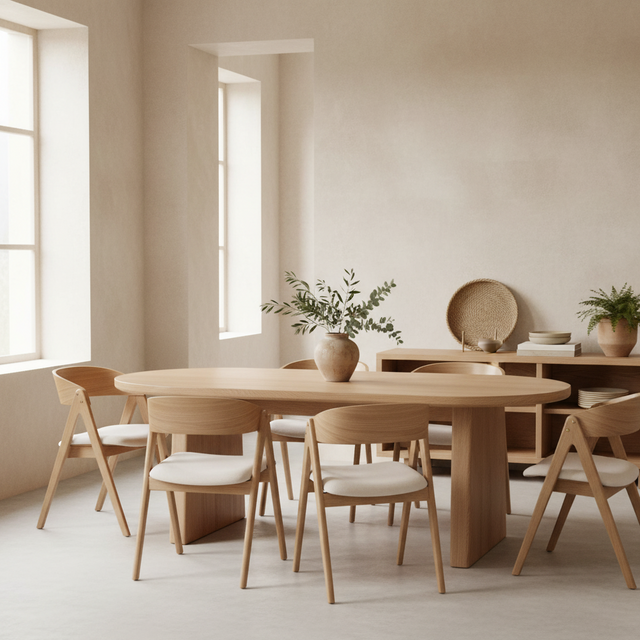
Solid wood vs. microcement: which will your living room choose in 2026?
Imagine walking into your newly renovated living room. On one side, a solid oak table radiates warmth in the afternoon light; on the other, a microcement wall projects the mineral calm you associate with boutique hotels. Both materials appeal to you, but your budget and lifestyle demand that you choose—or learn to combine them.
In 2026, solid wood and microcement are leading living room decor in Spain for opposing yet complementary reasons. Solid wood offers organic texture and an average durability of 25-50 years with basic maintenance; microcement provides continuous, water-resistant surfaces that can be applied in layers of just 2-3 mm thick. Choosing one or the other—or mixing them—depends on three factors: budget, desired maintenance, and decorative style.
Solid wood: warmth that ages well
Solid wood remains the most valued material in Nordic and natural style homes: a well-treated European oak furniture piece can exceed 40 years of useful life, and its price for living room furniture ranges between €800 and €3,000 per main piece, depending on the species and finish.
There is something difficult to replicate in authentic wood: the grain that changes with the light at every hour, the silky feel of a brushed ash board, that subtle aroma when you open a new drawer. At Slowdeco, a Nordic furniture store in Valencia, we work with woods such as oak, Nordic pine, and ash in our own collections like Cambra and Liure, designed for living rooms seeking authenticity without sacrificing clean lines. Brands like Teulat and Kodu opt for FSC-certified oak with water-based finishes, which means zero toxic emissions in your home.
Its weak point: solid wood requires protection against humidity (a varnish or natural oil every 12-18 months on intensely used surfaces) and is sensitive to sudden temperature changes. In a city like Valencia, where the average relative humidity is around 65%, it is advisable to choose stable species such as oak or walnut.
Microcement: the mineral continuity of the contemporary living room
Microcement is applied in layers of 2 to 3 mm over almost any existing substrate—tile, concrete, plasterboard—and its installation cost for floors is around €60-120/m² (material + labor), which for a 25 m² living room means between €1,500 and €3,000.
What seduces about microcement is its ability to eliminate joints: the floor, the wall, and even the open kitchen countertop merge into a single continuous surface. The result is a neutral canvas—in sand, pearl gray, or off-white tones—that visually expands any room. Its abrasion resistance exceeds 5,000 revolutions in the Taber test, which is equivalent to more than 15 years of domestic traffic without visible wear, provided a polyurethane sealant is applied every 3-5 years.
Its main limitation is tactile: microcement transmits cold in winter (unless underfloor heating is installed) and lacks that organic vibration that wood provides. For this reason, many current projects combine it with solid wood furniture to balance mineral coldness with natural warmth.
Practical comparison: price, maintenance, and style
To help you make the best decision, here are the key differences between solid wood and microcement applied to the living room. Price ranges correspond to the Spanish market in 2025-2026.
- Estimated price: Solid wood furniture ranges from €800-3,000 per piece; microcement floors cost €60-120/m² installed. A 25 m² living room in microcement can cost €1,500-3,000.
- Durability: Solid wood lasts 25-50 years and can be sanded and restored multiple times. Microcement maintains its appearance for 15-20 years with a resealing every 3-5 years.
- Maintenance: Wood requires oil or varnish every 12-18 months; microcement only needs cleaning with neutral pH products and periodic sealant.
- Thermal sensation: Wood is warm to the touch (thermal conductivity of 0.15 W/m·K); microcement transmits cold (0.90 W/m·K) unless underfloor heating is present.
- Decorative style: Wood fits Nordic, Japandi, rustic, and mid-century styles. Microcement dominates in industrial, minimalist, and contemporary Mediterranean.
- The winning combination in 2026: Microcement floor as a neutral base + solid wood furniture (sideboards, tables, modular shelves like Penxat from Slowdeco) to inject warmth and personality.
In summary
- Solid wood offers 25 to 50 years of useful life, can be restored multiple times, and provides a sensory warmth that no synthetic material has managed to match.
- Microcement costs between €60 and €120/m² installed, creates continuous surfaces without joints, and resists more than 5,000 revolutions of abrasion, ideal for high-traffic living rooms.
- The dominant trend in 2026 is to combine both: mineral base on floors and walls + solid wood furniture to balance coldness and warmth in the same space.
- At slowdeco.es and in the Valencia showroom (Avda. Pérez Galdós 127) you can see and touch solid wood collections like Cambra, Liure, and Penxat, designed to coexist with contemporary mineral finishes.
Frequently asked questions
Can solid wood and microcement be combined in the same living room?
Yes, and in fact, it is the most recommended formula in interior design in 2026. Microcement works as a neutral canvas on floors and walls, while solid wood furniture—an oak table, Nordic pine modular shelves—provides warmth and a focal point. The key is to maintain a palette of 2-3 tones to allow the overall look to breathe.
Which is more resistant to humidity in an area like Valencia?
Microcement is more resistant to surface humidity thanks to its waterproofing sealant layer. Solid wood, with an average relative humidity of 65% like Valencia's, requires stable species—oak, walnut, or ash—and a protective treatment every 12-18 months. If you choose the wood well and maintain it, both materials work perfectly in a Mediterranean climate.
How much does it cost to renovate a 25 m² living room combining both materials?
As a guide, a microcement floor for 25 m² costs between €1,500 and €3,000 installed. Adding a quality solid wood sideboard and dining table costs an additional €1,600 to €5,000. In total, the combined investment starts at around €3,100 and can reach €8,000 for high-end options, not including additional labor for painting or lighting.
Alicia Martínez
Interior Designer and Founder of Slowdeco
0 Comments
There are no comments for this article. Be the first one to leave a message!