
Vinyl, turntables, and the perfect TV stand: when sound defines your living room style
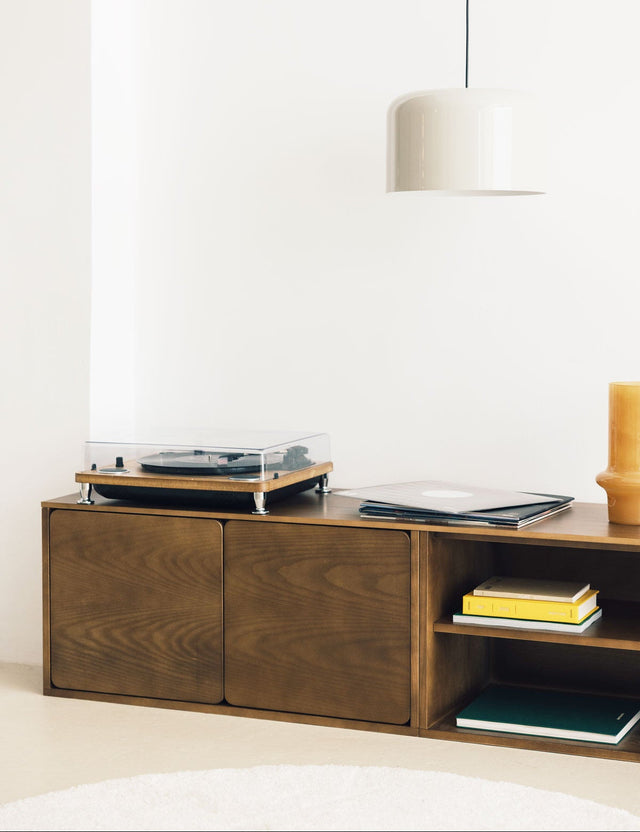
There's a gesture unlike any other: taking a record from its sleeve, lowering the needle, and standing still as the room fills with a sound that has body, that has texture. Listening to music on vinyl is a conscious decision, almost a ritual. And like any ritual, it needs a place that lives up to it. Not just any corner, but a piece of furniture designed with the same criteria you use to choose which record plays this afternoon.

Why vinyl has returned (and why it makes sense that it has)
Analog music didn't return out of nostalgia. It returned because there are people who distinguish between hearing and listening. A vinyl record forces you to be present: you choose it, you place it, you flip it halfway through. There's no algorithm to decide for you.
This gesture fits naturally with a specific way of understanding the home. If you care about the wood your furniture is made from, if you choose the pieces in your living room for how they make you feel and not just how they look, it's likely that listening to vinyl will feel coherent. It's the same logic: preferring what is authentic, tangible, what ages well.
Today's turntables have vastly improved in fidelity and construction. Brands like Pro-Ject, Rega, and Audio-Technica manufacture turntables with remarkable sound quality at reasonable prices. And the classics—a restored Thorens, a 1970s Dual—continue to function with satisfying solidity. Both new and old require a stable, level, and vibration-free surface. In other words: they need good furniture.
What a piece of furniture needs to coexist with a turntable
A turntable is not a decorative object you can place on any shelf. It is a sensitive mechanical instrument. The needle reads microgrooves, and any vibration—a footstep, a slamming door, a speaker too close—translates into distortion. That's why the furniture supporting it is as important as the device itself.
- Stability and weight: A solid wood cabinet absorbs vibrations much better than a low-quality board or a light metal structure. The more solid and dense the surface, the cleaner the sound will be.
- Level surface: The turntable needs to be perfectly horizontal. Furniture with adjustable legs or designs that provide even support are ideal.
- Space for records: A vinyl collection grows faster than you imagine. You need compartments or slots that allow records to be stored vertically, without deforming from their weight.
- Ventilation for the amplifier: If you use an external amplifier, the furniture must have sufficient depth and opening for the equipment to breathe. Open rear compartments or those with cable pass-throughs solve this cleanly.
- Visual proportion: A turntable has a strong presence. It needs furniture with proportionate lines that neither diminish nor overwhelm it. Low-profile designs, so typical of Nordic aesthetics, work particularly well.
Solid wood and analog sound: a natural affinity
It's no coincidence that the best audio furniture has always been made of wood. Solid wood has acoustic properties that no industrial material can replicate: it absorbs unwanted frequencies, dampens resonances, and brings a warmth to the environment that complements the texture of analog sound.
Oak, ash, and walnut—the woods we use most in Slowdeco collections—are particularly suitable. They are dense, close-grained woods that age and gain character. A solid oak TV cabinet not only supports a turntable well: it communicates with it. They share the same philosophy of being made to last.
Think about how acoustic instruments sound: a guitar, a cello, a grand piano. They all have wooden soundboxes. There is something deeply logical in having the furniture that accompanies your music made from the same material that has amplified it for centuries.
Slowdeco TV furniture that fits this universe
Not all TV cabinets are suitable for integrating analog audio equipment. We have selected pieces from our catalog that combine the necessary structural solidity with a clean-lined design and careful proportions.
The Teulat collection is a natural starting point. Its solid oak TV cabinets have low, wide profiles, with open compartments that allow for organizing records and audio components without sacrificing visual calm. The finish is clean, without unnecessary handles, and the wood is presented in natural tones that add warmth without overwhelming.
MOME furniture works with a slightly bolder, more impactful aesthetic. Its ash wood pieces have the density and weight that a turntable appreciates. The volumes are generous and the lines, serene. If your living room has high ceilings or plenty of space, a MOME piece provides the right scale.
The Kodu collection offers solutions with a more versatile approach. Its furniture combines solid wood with natural veneer details and structures that adapt well to medium-sized living rooms. They have good depth to accommodate amplifiers and side spaces where a vinyl collection can be neatly organized.
And Somcasa intelligently balances price, material, and design. Its TV cabinets maintain the Nordic aesthetic—restrained lines, light-profile legs, light tones—and offer practical compartments to organize all equipment without the overall look losing harmony.
How to set up a thoughtful listening corner
You don't need a dedicated room. All you need is a well-chosen TV cabinet, a quality turntable, and conscious decisions about space arrangement.
Place the turntable in the center or at one end of the furniture surface, never directly on top of the speakers. If you use bookshelf speakers, place them on independent stands or at the ends of the furniture, with a decoupling base—a simple piece of cork or felt can suffice—to prevent sound vibrations from reaching the needle.
Always store records vertically, like books. A vinyl record stored horizontally will warp over time from the weight of those on top. The open compartments of Nordic TV cabinets are perfect for this: they allow you to see the covers, access them easily, and keep the records ventilated.
Lighting also matters. A floor lamp with warm light next to the furniture creates the perfect ambiance for a listening session. No direct spotlights or cold light. Vinyl calls for a gentle dimness, the same as a well-thought-out living room.
A living room that sounds as good as it looks
Integrating a turntable into your living room is not a matter of trend. It's a decision that speaks to how you want to live in your home: with attention, with calm, choosing each piece for what it brings and not for what it appears to be. A good solid wood cabinet and a good vinyl record share this: they are made for you to enjoy slowly.
If you want to see and touch the Teulat, MOME, Kodu, and Somcasa collections, visit our showroom at Avda. Pérez Galdós 127, in Valencia. You can mentally bring your turntable—or a tape measure—and check in person which piece of furniture fits your equipment and your way of listening. You can also explore all the pieces at slowdeco.es and find the one that makes your living room sound exactly as good as it looks.
0 Comments
There are no comments for this article. Be the first one to leave a message!