
Modular furniture: how to design your custom living room
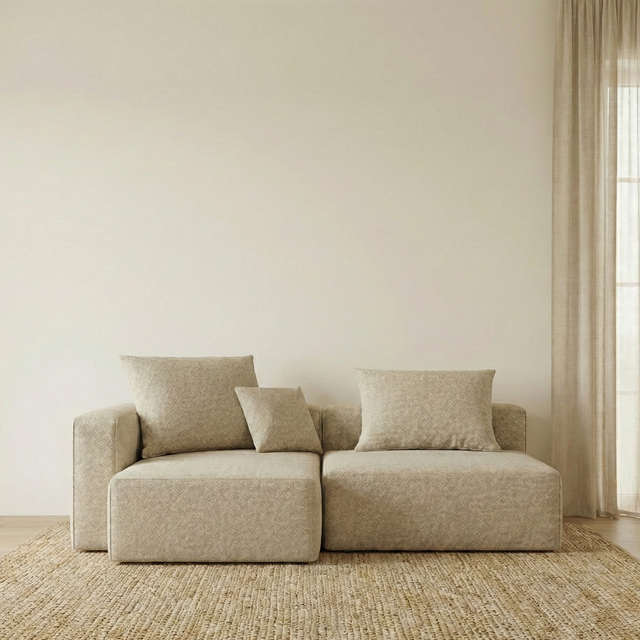
What are modular furniture pieces and why do they transform any living room?
Imagine coming home and your TV unit can expand when you buy a new console, or that sideboard that today measures 160 cm can become a 240 cm one when you move house. That's exactly what modular furniture allows.
Modular furniture consists of systems of independent pieces that combine with each other to create custom configurations. Unlike traditional furniture with fixed dimensions, modularity allows each piece to adapt to the exact dimensions of your space—from a 200 cm TV unit to compositions over 300 cm—and to modify it as your needs change, without replacing the entire set.

The real advantages of choosing modular furniture
A well-designed modular system can adapt up to 5 times throughout its lifespan, moving from a 60 m² apartment to a 120 m² house by simply adding modules. This flexibility represents an average saving of 40% compared to buying new furniture every time you change homes or needs.
Beyond the numbers, there's something deeply satisfying about a living room where every piece occupies exactly the space it should. At Slowdeco, we work with collections like Cambra, where 60 cm base modules allow you to create anything from a discreet 120 cm TV unit to a substantial 240 cm sideboard, all within the same aesthetic family of Nordic lines and natural wood finishes.
Modularity also solves one of the most common problems in decoration: those impossible measurements. A 187 cm gap between the fireplace and the wall, a column interrupting the living area... Independent modules adapt to real geometries, not to ideal living rooms that only exist in catalogs.

How to design your modular composition step by step
The design process always begins by accurately measuring the available space, leaving at least 5-10 cm of margin on each side for visual circulation. A 240 cm TV unit needs a wall of at least 260 cm to breathe properly.
1. Define your focal point
In 78% of Spanish living rooms, the television remains the visual center. For 55-65 inch screens (the best-selling in 2024), a TV unit between 180 and 200 cm offers balanced proportions. If your television is 75 inches or larger, go for compositions of at least 240 cm.
2. Calculate your storage capacity
Inventory what you need to store: multimedia devices, books, decorative objects, tableware if it's a living-dining room. Each closed module is approximately equivalent to 80 liters of storage. An average composition of 4 modules offers about 320 liters, enough for most homes.
3. Alternate open and closed
The 60-40 rule almost always works: 60% closed modules (to hide cables, remotes, less aesthetic items) and 40% open or with glass (to display beautiful pieces and provide visual lightness). Collections like Cambra allow combining plain doors with exposed shelves in the same natural oak finish.
Decorative styles that work best with modular systems
Modular systems reach their full potential in styles where clean lines and functionality are paramount. Nordic, Japandi, and warm minimalist styles leverage modularity as a philosophy, not just a practical solution.
- Classic Nordic: Modules in light oak or matte white, tall legs (12-15 cm) that show the floor and add lightness. Asymmetrical combinations with spaces for plants.
- Japandi: Fewer pieces, more robust. Low modules (maximum height 45 cm), finishes in dark wood or matte black, integrated handles or push systems.
- Warm Minimalism: Large smooth fronts in sand or taupe tones, modules suspended 20 cm from the floor with lower LED lighting.
- Contemporary Mediterranean: Mix of natural wood with white lacquers, 200 cm sideboards that function as buffets in spacious living-dining rooms.
In our Slowdeco Valencia showroom (Avda. Pérez Galdós 127), you can see and touch these configurations set up in a real environment, something no screen can replace when it comes to wood textures and proportions.

In summary
- Modular furniture allows for 3 to 5 reconfigurations throughout its lifespan, adapting to moves and changing needs without replacing the entire set.
- For a balanced TV unit, apply the rule of leaving 30-40 cm more than your TV's width on each side; a 65" screen calls for a unit of at least 180 cm.
- The 60-40 proportion between closed and open modules ensures functional storage without losing visual lightness in the living room.
- Slowdeco's modular collections, like Cambra, offer 60 cm base modules combinable into compositions over 300 cm, available in our online store and showroom in Valencia.
Frequently Asked Questions
Can I expand a modular furniture piece years after buying it?
It depends on the collection. Series from established manufacturers like those you'll find at slowdeco.es maintain their references for at least 5-7 years, allowing you to add modules with the same finish. We always recommend confirming availability before planning major expansions, as natural wood tones may vary slightly between production batches.
What size TV unit do I need for my television?
The general rule is to add between 60 and 80 cm to the width of your television. For a 55-inch TV (122 cm wide), a 180-200 cm unit works perfectly. For 65 inches (145 cm), look for compositions of 200-220 cm. This ensures the unit frames the screen without being too small or disproportionate.
Are modular pieces more expensive than traditional furniture?
The initial investment may be similar or slightly higher (between 10-15% more), but the cost per year of use is significantly lower. A quality modular furniture piece that adapts to three different homes over 15 years turns out to be more economical than buying three different conventional furniture pieces.
Alicia Martínez
Interior Designer and Founder of Slowdeco
0 Comments
There are no comments for this article. Be the first one to leave a message!