

How to organize your books and decorative objects
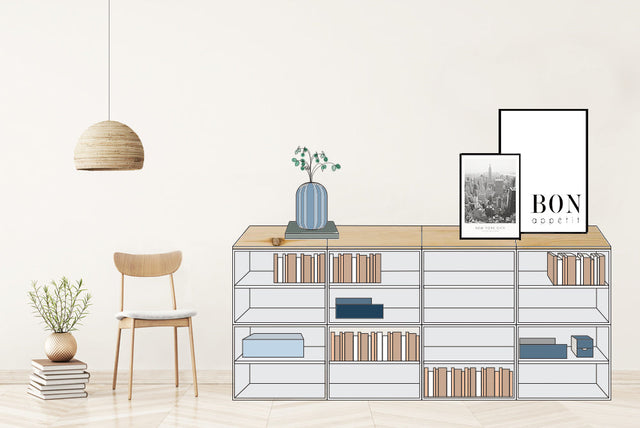
Organizing books and decorative objects on shelves transcends mere storage functionality, becoming a compositional art where each element contributes to a coherent visual narrative that reflects personality while maintaining practical order. ideas for decorating a bookshelf Effective solutions balance aesthetic considerations with functional accessibility, creating displays that are simultaneously beautiful and useful, where finding what you need is intuitive without sacrificing visual impact. salon organization In contemporary design, open shelving functions as personal galleries that display collections of books, objects with emotional significance, and carefully curated decorative elements, transforming storage systems into architectural focal points that define the character of the space and communicate the identities of those who inhabit it.
Step-by-step guide to organizing your bookshelf
Step 1: Completely empty and evaluate content
Begin by removing absolutely everything from your shelves and placing it on a large surface where you can see it all at once. This complete decluttering process allows you to objectively assess what you truly own, often revealing forgotten duplicates, broken items you never repaired, or pieces that no longer resonate with your current aesthetic. A thorough view of your inventory facilitates conscious decisions about what deserves to remain on display versus what should be stored, donated, or discarded.
While you're emptying, thoroughly clean each shelf of the rack Remove accumulated dust from corners and crevices that are usually inaccessible with objects in place. This thorough cleaning prevents old dust from contaminating objects when you move them around, which is especially important for books whose pages absorb particles. Use a slightly damp cloth followed by complete drying before you begin rearranging, ensuring the wood is completely dry to avoid moisture damage.

Group removed items into broad categories: books separated by genre or subject, decorative objects grouped by material or function, and personal items like photographs or mementos together. This preliminary categorization facilitates the next curation phase, where you decide what stays and what goes. For books, consider creating subcategories by author, subject, or frequency of use, which will later influence their specific placement on the reorganized bookshelf.
Step 2: Curate collection by applying selective criteria
Conscious curation represents a fundamental difference between a chaotically cluttered shelf and an intentionally curated display. It applies selective criteria by questioning each object: Do I use it regularly? Does it have genuine emotional significance? Does it aesthetically contribute to the desired composition? Does it bring me joy to see it daily? This honest questioning often reveals that many objects remain simply out of habit, adding no real value and occupying space that more meaningful items deserve.
For books, be especially critical of those you've never read and are unlikely to read, duplicate editions of works you own in better formats, or academic texts from past stages that you no longer consult. Keep first editions with sentimental value, reference books you consult regularly, and readings you genuinely plan to tackle soon. modular systems They allow you to expand capacity if your library grows, freeing you from having to keep everything for fear of running out of space in the future.

Decorative objects deserve similar scrutiny: travel souvenirs that no longer represent a meaningful experience, gifts you keep out of obligation without truly enjoying them, or items you bought impulsively that don't fit into a coherent aesthetic can all be removed, freeing up visual space. This rigorous editing doesn't mean extreme minimalism but rather conscious curation where each displayed object serves a specific aesthetic or functional purpose, actively contributing to the composition instead of simply occupying available space.
Step 3: Plan a balanced visual composition
Before putting items back on the shelf, plan the overall arrangement, considering visual balance, color rhythm, and functional groupings. Photograph your empty shelf to use as a mental or digital template to visualize different configurations before physically implementing them. This advance planning prevents frustrating multiple rearrangements when you discover that an improvised layout doesn't work visually.
Apply the rule of thirds by mentally dividing each shelf into three sections, placing focal points at the intersections of dividing lines where the eye is naturally drawn. This photographic principle translates perfectly to shelf compositions, creating balanced displays without boring, rigid symmetry. Cosit shelving With square modules of 80x40 cm, each cube functions as an individual frame where this rule can be applied.

Consider height, visual weight, and color when planning placement: tall objects at the ends of shelves create verticality, visually heavy (dark, dense) elements on lower levels stabilize the composition, and colors are distributed to create a rhythm that guides the eye across the entire shelf. Draw a simple sketch indicating where book groupings will go, where prominent decorative elements will be placed, and where negative space will allow the composition to breathe, preventing overcrowding.
Step 4: Organize books using combined strategies
Organized by color
The chromatic arrangement of books creates a spectacular visual impact, generating rainbow gradations that transform the library into an art installation. Books are grouped by color families, creating sections of reds, oranges, yellows, greens, blues, and violets that flow naturally along the spectrum. This strategy prioritizes aesthetics over thematic functionality, making it appropriate when the bookshelf primarily serves as a decorative element rather than a frequently consulted library.
To effectively implement color organization, consider saturations and values within each family: group pastel tones separately from intensely saturated ones, avoiding mixtures that break visual coherence. White, black, and gray books function as neutrals that you strategically separate between colorful sections, providing visual pauses that prevent saturation. wooden shelves natural contrasts beautifully with colorful backs, enhancing chromatic vibrancy.
The main limitation of color-coded organization is the difficulty in finding specific titles, requiring the memory of spine color versus thematic location. Mitigate this problem by photographing the organized bookshelf and creating a digital inventory where you note the approximate location of important titles, facilitating future searches without disrupting the carefully constructed color scheme.
Organization by size
Grouping books by height creates visually calm, orderly horizontal lines, especially effective in salon organization Minimalist style where visual discipline is paramount. Place tall volumes together to create dramatic vertical sections, medium-sized books in their own groupings, and small formats grouped or leaned horizontally to prevent them from disappearing among more imposing neighbors.
Organizing by size optimizes space utilization by allowing you to adjust shelf heights according to the books they will hold, eliminating vertical dead space when small books occupy high shelves. In shelving units with adjustable shelves, you can reconfigure heights, creating precise spaces for each size category and maximizing overall capacity. This space efficiency is especially valuable in large libraries where every centimeter counts.
It combines size-based organization with thematic organization to create a hybrid system where novels are grouped by height within the general fiction section, and essays by size within nonfiction. This approach maintains thematic search logic, facilitating the discovery of categories, while the visual benefit of dimensional uniformity improves overall appearance.

Thematic/alphabetical organization
The thematic or alphabetical organization prioritizes functionality over aesthetics, making it appropriate for frequently consulted libraries that require quick retrieval of specific titles. It groups fiction separately from non-fiction, subdivides fiction by genre (historical novel, science fiction, mystery), and organizes non-fiction by subject (history, science, art). Within each category, it alphabetizes by author's last name, facilitating systematic searches.
This professional library-style organization works exceptionally well in studios or workspaces where books are regularly consulted tools rather than purely decorative elements. The visual aspect may be more eclectic than chromatic or dimensional arrangements, but the gains in usability more than compensate for this for avid readers who constantly interact with their collection.
Duck closed storage modules This allows for the storage of occasional reference books or less visually appealing editions, while open shelves display only volumes with beautiful spines that contribute positively to the overall aesthetic. This hybrid open-closed strategy balances complete functionality with a carefully curated presentation.
Step 5: Strategically integrate decorative objects
Trio grouping technique
Grouping decorative objects in trios creates visually pleasing compositions by taking advantage of the human brain's predisposition to find odd numbers attractive. It involves grouping three elements of varying heights to create a visual triangle where the tallest object anchors the composition, the medium-sized object provides a transition, and the shortest object completes the grouping. This technique works well with vases, candles, small sculptures, or natural elements, creating cohesive vignettes.
Vary materials within each trio to add tactile interest: combine matte ceramic with glossy glass and natural wood, or metal with stone and textile. This material diversity prevents monotony while numerical unity (three elements) maintains compositional coherence. ideas for decorating a bookshelf The most effective ones balance repetition (which unifies) with variation (which is of interest), a balance that trios of diverse materials achieve perfectly.

Distribute trios at different shelf heights, creating a vertical rhythm that guides the eye from top to bottom, exploring the entire composition. Avoid placing all the trios in the center of shelves; alternate some aligned to the left, others to the right, creating a dynamic asymmetry that maintains visual interest. Modular shelving , each module can contain an independent trio creating a grid of related compositions.
Layers and depth
Utilize the full depth of shelves by creating layers that add dimension to flat displays. Place tall objects or books against the back wall, medium-sized items in the middle, and small or short pieces in front, creating a tiered effect that allows all items to be viewed simultaneously. This layering prevents objects at the back from being completely hidden, maximizing the visibility of the entire collection.
Lean framed pictures or prints against the back wall of shelves, leaving them slightly tilted. This technique adds an elegant casualness to the otherwise rigid hanging installation. Partially overlap frames to create informal collages where different sizes and orientations (vertical/horizontal) generate dynamic compositions. This approach also makes it easy to rotate art frequently without drilling into walls.
Small three-dimensional objects such as sculptures, plants, or natural elements are placed frontally where their volume is fully appreciated. This frontal arrangement takes advantage of depth. Cosit shelving 33 cm, allowing three-dimensional objects to have room to breathe without being squashed against back books.

Intentional negative spaces
Empty space on shelves serves a compositional function as important as the objects displayed, providing visual pauses where the eye rests and preventing saturation. Leave at least 20-30% of each shelf empty, creating breathing room that allows displayed objects to stand out rather than compete in a crowded display. This negative space emphasizes adjacent objects through direct contrast between full and empty.
Group empty spaces strategically rather than distributing them evenly: a completely empty shelf end creates intriguing asymmetry, while empty central sections generate negative frames around flanking objects. This intentional use of emptiness demonstrates conscious curation versus the accidental appearance of spaces you simply haven't filled yet.
Empty spaces also facilitate maintenance, allowing easy access for cleaning without having to remove dozens of items. Consider this practicality when planning your layout: more accessible lower shelves can be stocked at a higher density, while less accessible upper shelves benefit from greater empty space, reducing the frequency of cleaning needed in hard-to-reach areas.
Step 6: Add natural elements and texture
Plants that bring life
Plants transform static shelves into living displays that evolve organically, adding invaluable biophilic freshness to urban spaces. Select low-maintenance plants appropriate for the specific light conditions of your shelf: pothos, sansevieria, or ZZ plants tolerate the indirect light typical of middle shelves, while succulents require upper shelves near windows with abundant direct sunlight.

Vary plant heights using tall pots that add vertical dimension, hanging plants whose stems cascade dramatically from upper shelves, and compact specimens that occupy small spaces between books. This variation in sizes creates an organic dynamism impossible to achieve with inanimate objects, literally adding life to a composition that breathes and grows.
Coordinate planters with the overall color palette of your shelving: neutral ceramics in white, gray, or natural terracotta work universally, while colorful planters can echo the tones of book spines, creating chromatic threads. Baskets made of natural fibers add an organic texture appropriate for bohemian or Mediterranean aesthetics, available at shelving accessories .
Contrasting textures
Introduce diverse textures through objects that invite tactile contact, creating a multidimensional sensory experience. Combine the softness of textiles (decoratively folded blankets, small cushions) with the hardness of glazed ceramics, the roughness of woven basketry with the smoothness of glass, and the warmth of wood with the coolness of metal or stone. This tactile variety adds sensory richness that mono-textured compositions cannot achieve.
Woven items—baskets, wicker trays, rattan boxes—bring visible craftsmanship where the manufacturing technique is part of the aesthetic appeal. Use them to group small objects that individually would create visual clutter: remote controls, keys, small souvenirs are hidden in a beautiful basket that serves both decorative and functional purposes. This "hidden in plain sight" strategy maintains accessibility without sacrificing aesthetics.
Soft textiles like blankets or runners add literal and figurative warmth, especially valuable in wooden shelves where the contrast between the architectural hardness of the structure and the softness of the textiles creates a pleasurable tension. Fold a blanket into thirds and place it horizontally on a stack of books, or let it fall casually from a top shelf, adding implicit movement to a static composition.

Step 7: Lighting that enhances displays
The lighting transforms shelves of functional items by day into luminous sculptures that become the stars of the night. It incorporates ultra-thin LED strips along the underside of each shelf, projecting downward light that illuminates objects on the shelves below, a technique that creates a dramatic gradation of light. This accent lighting highlights selected objects, turning the entire shelving unit into a personal gallery where each item receives the spotlight it deserves.
Directional spotlights allow you to illuminate specific objects from a distance, making them ideal when integrated LED lighting isn't feasible. Position spotlights on the ceiling or opposite walls, focusing on key pieces you wish to emphasize: significant sculptures, particularly beautiful plants, or beautifully arranged compositions. This selective lighting creates a nighttime hierarchy where certain elements shine brightly while others are subtly obscured.
For salon organization Where shelving functions as a significant architectural element, consider adjustable RGB lighting that allows you to change the color and atmosphere according to the occasion: warm, cozy light for quiet evenings, cool and clear light for work or reading, or colorful tones for festive events. This chromatic lighting flexibility multiplies the shelving's versatility, adapting it to different moods or functionalities of the space.
Accessories and complementary modules
Closed storage modules
The Liure storage modules These drawers integrate seamlessly into open shelving, providing closed storage for items you'd rather keep out of sight. These soft-close, white lacquered drawers are perfect for storing documents, office supplies, board games, or less visually appealing items that you need accessible but not on display. The alternating open and closed compartments create a dynamic visual rhythm, preventing the monotony of completely open shelves.
Strategically place closed modules on middle levels while keeping upper and lower shelves open, a configuration that visually anchors the composition while preserving openness at the ends. This layout allows upper decorative displays to stand out without competition, while lower levels remain accessible for frequently used items. The white lacquered modules contrast elegantly with the natural wood of Cosit shelving creating sophisticated material duality.

Handmade baskets and organizers
Handwoven baskets made from natural fibers are available at shelving accessories They add organic texture while organizing small objects that individually would create visual chaos. Use uniform baskets on each shelf, creating coherence through repetition, or vary sizes and textures, adding controlled diversity. The visible handcrafted weaving celebrates the manufacturing process, becoming a decorative element that simultaneously serves an organizational function.
Wooden organizers with multiple compartments structure deep desk drawers or lower shelves, dividing space into sections where each category of item has a specific location. This compartmentalization prevents small items from getting lost at the bottom of deep drawers, keeping everything visible and accessible. ideas for decorating a bookshelf Prioritizing functionality without sacrificing aesthetics, these organizers represent a smart investment in lasting organization.
Book stands and bookends
Sculptural bookends function simultaneously as necessary structural elements and striking decorative objects. Select designs in metal, stone, wood, or ceramic that complement the overall aesthetic, adding visual weight that anchors groupings of books. Marble bookends bring mineral luxury, industrial metal adds a contemporary edge, and natural wood maintains organic warmth.
Use bookends to create subsections within long shelves, dividing a large library into visual chapters that facilitate navigation. This segmentation with bookends generates horizontal rhythm by alternating groupings of books with decorative objects, a technique that prevents the monotony of continuous books occupying linear meters without interruption. The careful alternation of solid (books) and three-dimensional elements (objects between sections) creates essential visual breathing room.
Long-term organizational maintenance
Seasonal rotation system
Implement a seasonal rotation of decorative objects to maintain a fresh composition without requiring constant investment in new items. Store 30-40% of your decorative objects in storage, rotating them between seasons: autumnal items (decorative pumpkins, warm tones) in October-November, spring items (florals, pastels) in March-May. This regular rotation refreshes the look of your shelves, creating a new and visually stimulating space for you and your visitors.
Rotation also facilitates deep cleaning by removing items seasonally, providing a perfect opportunity to thoroughly clean shelves and assess whether the current setup is working or needs adjusting. This regular review prevents inertial accumulation where items remain indefinitely unquestioned, maintaining active, conscious curating instead of allowing a drift toward gradual disorganization.
Rule of one in, one out
Maintain a disciplined collection by applying the rule that acquiring a new book or decorative object requires removing an existing one, preserving a curated balance and avoiding progressive accumulation. This policy forces a conscious evaluation of each addition: Does this new object deserve to displace something I currently own? Does it contribute more significantly to the overall composition than existing items? This questioning prevents impulsive purchases, maintaining a genuinely curated collection.
For active libraries where constant acquisitions are inevitable, consider expanding shelving by Cosit modular system It grows organically by adding modules as needs evolve. This scalability allows the library to expand without compromising organization or forcing the removal of beloved volumes—a slow living philosophy where furniture adapts to life rather than life adapting to the limitations of static furniture.

Photograph documenting evolution
Photograph your organized bookshelf from the same angle every three months, creating a visual record of its evolution. This documentation reveals patterns: Do certain items constantly migrate? Do some shelves remain perfectly organized while others become disorganized? Does the overall composition improve or deteriorate over time? These insights inform future adjustments, allowing you to learn from accumulated experience and continuously refine your personal approach to organization.
The photographs also serve as a reference when you need to reorganize after a deep clean, reminding you exactly where each item was in its previous successful configuration. This visual memory eliminates the frustration of trying to reconstruct a working layout without remembering specific details, facilitating a quick return to a proven organization after necessary temporary disruptions.
Organizing books and decorative objects on shelves represents a delicate balance between practical functionality and aesthetic composition, where each element contributes to a coherent visual narrative that authentically reflects personality. ideas for decorating a bookshelf The most successful ones recognize that beautiful displays don't arise accidentally but through conscious curation, compositional planning, and disciplined maintenance that preserves order without excessive rigidity. In salon organization contemporary, the open shelving They function as personal galleries where beloved books, meaningful objects, and carefully selected decorative items create displays that are simultaneously functional and artistic.
The modular systems Cosit products facilitate evolving organization that grows with you, adding modules as collections expand without requiring complete furniture replacements. specialized accessories —Handcrafted baskets, closed modules, organizers— enhance functionality by transforming basic shelving into sophisticated storage systems that conceal clutter while showcasing beauty. The initial investment of time in mindful organization pays off through years of daily satisfaction as you interact with displays that inspire you, reflect your identity, and make it easy to find exactly what you need when you need it, demonstrating that well-designed organization doesn't limit but rather liberates, allowing objects you love to shine without chaotic competition from superfluous items.
0 Comments
There are no comments for this article. Be the first one to leave a message!