
Dark wood in the living room: how to decorate with chocolate tones
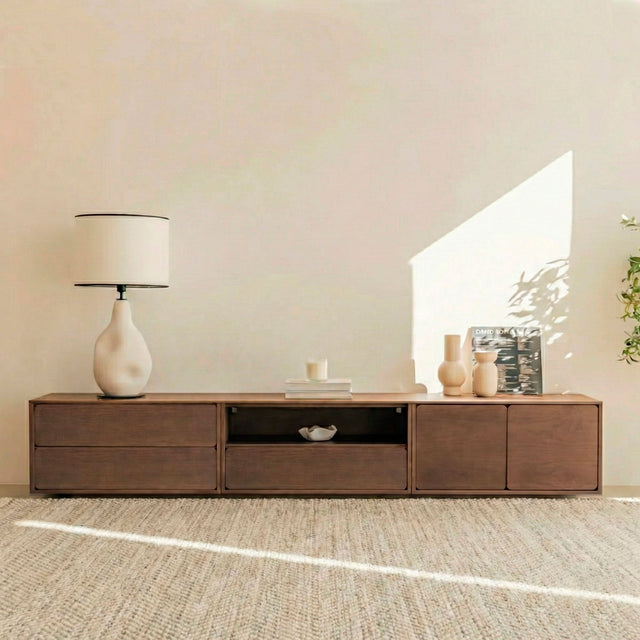
Imagine a living room where the afternoon light filters through linen curtains and falls on a walnut sideboard. The dark wood immediately adds warmth, but many hesitate: will it reduce brightness? Will it fit with the Nordic style?
Dark wood —walnut, toasted oak, or wenge— can be perfectly integrated into a Nordic living room if you balance its presence with light walls, natural textiles, and well-distributed lighting. The key is that dark furniture should occupy a maximum of 30-40% of the visible furniture, reserving the rest for neutral tones and materials such as rattan or raw linen.
Why dark wood works in Nordic style
Scandinavian design is not synonymous with all-white. Danish and Norwegian interiors have incorporated chocolate woods since the 1950s, when designers like Finn Juhl popularized dark teak. The Nordic trick is simple: a light background, a dark accent piece, maximum contrast with minimum visual weight.
In a 20 m² living room, a toasted oak TV cabinet or a walnut coffee table acts as a visual anchor without overwhelming. Think of Slowdeco’s Cambra collection, with clean lines that allow the wood to breathe. The result is a space that conveys sophistication without coldness, a refuge without heaviness. Dark wood absorbs 15% to 25% more light than natural oak, which is why it needs bright companionship: off-white walls (codes like NCS S 0502-Y or Jotun 1001) and light floors multiply the feeling of spaciousness.

How to choose the ideal chocolate wood tone
Not all dark woods are the same. American walnut has a warm tone with golden veins; smoked oak is more grayish and contemporary; wenge tends towards black with reddish undertones. Choosing well depends on the natural light temperature your living room receives: south or east orientation allows for cooler tones; north or west calls for woods with warm undertones.
If your living room in Valencia receives intense Mediterranean light, American walnut or toasted oak will provide depth without darkening. For apartments with less natural light, consider smoked oak combined with matte finishes — the extra shine reflects light and softens the overall darkness. At slowdeco.es you will find sideboards and shelves from the Nolla collection in natural oak that you can combine with darker pieces to achieve that balance.
What colors and materials combine best
Chocolate wood reaches its full potential alongside a palette of warm whites, sandy beiges, stone grays, and muted greens. This combination, present in 78% of contemporary Nordic interior design projects, creates depth without sacrificing brightness.
Textiles are your allies: oatmeal linen cushions, jute or raw wool rugs, light curtains that filter without blocking. Introduce brushed brass or matte black in lamps and handles to complete the palette. Rattan and wicker, present in chairs or baskets, add texture and lighten the visual weight of dark wood. The rule of three materials works: dark wood + light textile + natural fiber = perfect balance.

Comparison: most used dark woods in Nordic living rooms
- American Walnut: Warm tone with golden veins. Hardness 1010 Janka. Medium-high price (from €180/m² in furniture). Ideal for living rooms with north or west light.
- Smoked Oak: Contemporary gray-brown. Hardness 1360 Janka. Medium price (from €120/m²). Versatile for any orientation, very resistant.
- Toasted Oak: Medium brown with warmth. Hardness 1360 Janka. Medium price (from €110/m²). The easiest to integrate into Nordic style.
- Wenge: Almost black with reddish undertones. Hardness 1630 Janka. High price (from €220/m²). Use sparingly, maximum 1-2 pieces per room.
In summary
- Dark wood furniture should occupy a maximum of 30-40% of the visible furniture to maintain the brightness of the Nordic living room.
- American walnut and toasted oak are the most versatile chocolate tones; wenge requires more natural light and should be used sparingly.
- Combine dark wood with warm white walls (NCS S 0502-Y or similar), linen textiles, and natural fibers such as jute or rattan.
- At Slowdeco, a Nordic furniture store in Valencia and online, you will find collections like Cambra and Nolla to create that balanced contrast between light and dark woods.
Frequently asked questions
Does dark wood make the living room look smaller?
Only if it dominates the space. A 18-25 m² living room can perfectly accommodate a large TV cabinet or a sideboard in chocolate wood if the rest of the furniture is light. The key is to maintain the 30-40% dark, 60-70% light proportion, and ensure that the walls and floor are bright neutral tones.
Can I mix dark wood with light wood in the same living room?
Yes, and in fact, it is the most used formula in current Nordic interior design. Combine natural oak pieces with a coffee table or sideboard in walnut. The trick is that they share the same finish (both matte or both satin) so that the mix is intentional, not accidental.
What lighting does a living room with dark wood furniture need?
Opt for warm light (2700-3000 K) at various heights: a floor lamp next to the sofa, wall sconces or LED strips near the dark furniture, and diffuse overhead light. Chocolate wood absorbs more light than light wood, so calculate 20% more light points than in an all-white living room.
0 Comments
There are no comments for this article. Be the first one to leave a message!