
Modular sofas for small living rooms: how to choose size and layout
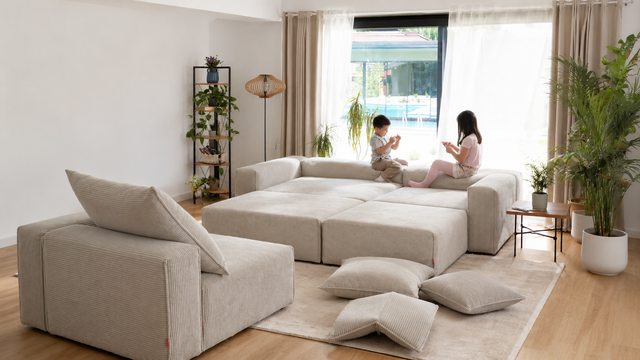
You have a fifteen-square-meter living room and the feeling that no sofa fits. Too long, too deep, too rigid in its shape. The problem is usually not the space, but the rigidity of the furniture. A conventional sofa forces you to adapt to it. A modular sofa does just the opposite: it adapts to your living room, to your life, and to the changes that may come.
If you've been measuring walls and comparing dimensions for weeks without finding the right piece, this guide will save you a lot of doubt. We'll talk about how to choose a small modular sofa with discretion, how to arrange it in a living room with limited space, and why modularity is one of the smartest decisions you can make for your home.
What makes a modular sofa different (and better for small spaces)
A modular sofa is made up of independent pieces—modules—that combine with each other. You can join them, separate them, rearrange them, or expand them. You don't buy a fixed sofa: you buy a system that grows with you.
In a small living room, that makes all the difference. Because you don't have to give up comfort or settle for a tiny two-seater. You need a sofa that takes up exactly what it should, not an inch more, not an inch less.
Moreover, if your life changes—you move, renovate, someone new comes home—modular living room furniture can be reconfigured without you having to buy new pieces. It's an investment that truly stretches over time.
Feydom: precisely designed modularity
Within our catalog, we work with Feydom, a brand specializing in modular sofas that understands modularity as more than just breaking a sofa into pieces. Each Feydom module is designed to work alone or in combination, with careful proportions, natural fabric upholstery, and solid construction that avoids low-quality boards or materials that age poorly.
What we like about Feydom is its consistency. Its lines are clean, its shapes soft, and they fit naturally into a Nordic or Mediterranean style living room where visual calm and natural wood are protagonists. You don't compete with the sofa for attention: the sofa integrates.
Its module connection systems are firm but easy to manipulate, allowing you to reconfigure the sofa's arrangement in the living room without tools or effort. That makes a difference in daily life.
How to choose the right size for a small living room
Before falling in love with a composition, measure. But don't just measure the space where the sofa will go. Also measure circulation paths, the distance to the coffee table, door openings, and the space you need to live comfortably around the furniture.
A useful rule: leave at least 45 centimeters clear between the sofa and any other furniture or passageway wall. If the living room is also a dining room, that distance is sacred to allow the space to breathe.
- Living rooms under 15 m²: opt for a two-module composition, like a two-seater. A base module plus an arm module is usually enough. Feydom allows you to start this way and add pieces later.
- Living rooms from 15 to 20 m²: you can consider an L-shaped composition with three modules. The corner utilizes the space and frees up the center of the living room, which gives a sense of spaciousness.
- Long and narrow living rooms: avoid L-shaped compositions that block passage. Better a straight line of two or three modules against the long wall, leaving the opposite side clear.
- Square living rooms: here the L works very well. Place it in a corner and orient it towards the window or the focal point (fireplace, TV cabinet). The remaining space is clean and traversable.
A common mistake is choosing modules with overly generous seat depth. For small living rooms, look for depths between 85 and 95 centimeters. Enough to sit comfortably, without the sofa devouring the room.
Sofa arrangement in a small living room: three schemes that work
The arrangement of a sofa in a small living room is not just a matter of where you put it. It's a matter of the relationship you create between the sofa and the other elements.
1. Against the main wall. This is the most direct option and the one that works best in rectangular living rooms. The modular sofa rests against the longest wall, the coffee table is in front, and the passage remains clear. Simple, effective, and visually orderly.
2. In a corner, forming an L. Ideal when you have an unused corner. Feydom's L-shaped composition hugs the corner and creates a cozy, almost enveloping seating area. This is the arrangement that best balances comfort and space utilization in tight spaces.
3. As a room divider. If your living room shares space with the dining room, placing the modular sofa with its back to the dining area creates a natural division without walls or shelves. For this, the back of the sofa needs a clean finish, something Feydom takes care of in its designs.
The real advantages of modularity in everyday life
Beyond theory, modularity solves very specific situations that anyone living in a small apartment will recognize.
- Immediate adaptation: guests arrive and you need more seating. You separate a module, move it closer to the table or to the other side of the living room, and you have an extra seat without moving heaven and earth.
- Seasonal reconfiguration: in summer you want the sofa closer to the window; in winter, more tucked towards the center. With independent modules, you can change the composition in five minutes.
- Progressive growth: you start with two modules because that's what you need—and what fits—now. Next year you add a third. The investment is spread out, and the sofa grows with you.
- Hassle-free transport: individual modules fit through narrow doors, difficult stairs, and small elevators. In many city apartments, this is not a minor detail: it's what makes it possible to have a good sofa.
- Easier maintenance: if a module wears out more, you can replace only that piece or change its cover without touching the rest.
Materials and fabrics: what really matters
In a small living room, the sofa occupies a large percentage of the visual field. Its color, texture, and volume define the character of the room almost as much as the walls. That's why what you touch and what you see matters.
Natural fabrics in neutral tones—creams, soft grays, earth tones, moss green—provide chromatic harmony and allow the sofa to coexist harmoniously with the natural wood of the floor, shelves, or table. It's the basic principle of Nordic style applied to the living room: few elements, well-chosen, that breathe together.
Feydom offers durable fabrics with a pleasant feel, designed for real daily use. We don't look for showroom sofas, but pieces that are lived in and age well.
Before deciding: the questions you should ask yourself
- How many people sit on the sofa daily? This determines the minimum number of modules.
- Does the living room have a dual function (living and dining, living and working)? If so, the layout is as important as the size.
- Is there a possibility that in one or two years you will need more seating? If the answer is yes, modularity is not a whim, it's pure logic.
- Where does natural light come from? Place the sofa so that it doesn't block it. A well-lit small living room always seems larger.
Answering these questions before buying saves you returns, regrets, and that uncomfortable feeling that something just doesn't quite fit.
Come and try it: a sofa is chosen by sitting on it
Measurements can be found on a technical sheet. The firmness of the seat, the real depth when you sink into it, and the feel of the fabric against your skin, cannot. That's why we have Feydom modular sofas in our showroom in Valencia, at Avda. Pérez Galdós 127, where you can sit, move the modules, try out compositions, and leave with the certainty that you've made the right choice.
You can also explore the compositions available at slowdeco.es, where you'll find the exact measurements of each module, fabric options, and the combinations that work best for living rooms with limited space. If you have any questions about arrangement, write to us: helping to fit the pieces together is one of the things we do best.
0 Comments
There are no comments for this article. Be the first one to leave a message!