

Sustainable materials in furniture manufacturing
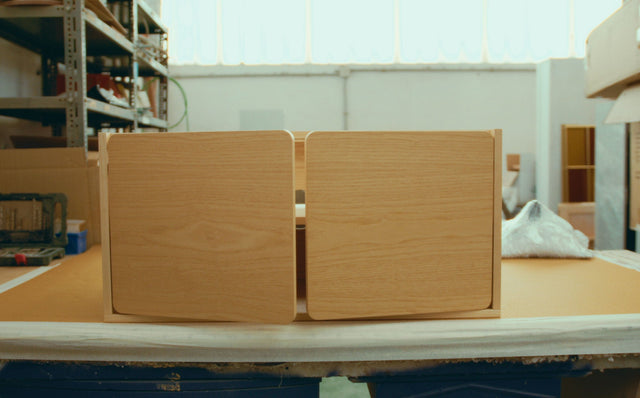
You've probably wondered at some point what goes into that piece of furniture you have at home. Beyond the pretty design or the price you paid, there's a whole process that makes the difference between just any piece of furniture and one that's truly worthwhile. These days, choosing sustainable materials in furniture manufacturing isn't just a passing trend; it's a responsibility to our planet and to the people who work to create those unique pieces that bring life to your home.
In this article, you'll discover how choosing natural materials and artisanal processes completely transforms the quality, durability, and environmental impact of your furniture. I'll tell you firsthand how we work in our carpentry workshops in Valencia, what woods we use, why we opt for eco-friendly lacquers, and how personalizing each piece makes your furniture truly special.
In the end, you'll understand why investing in locally made, sustainable furniture is the best decision you can make for your home and for the future.
Why materials matter in your furniture
When you choose a piece of furniture, you're not just buying a decorative object. You're making a decision that affects your health, the environment, and the local economy. Sustainable materials make all the difference between a piece of furniture that lasts for decades and one that will end up in the landfill in just a few years.
High-quality solid wood, sourced from responsibly managed forests, can last for over 50 years with proper care. Compare that to cheap particleboard that deteriorates in less than five years. The difference isn't just in durability, but also in the atmosphere you experience every day in your home.
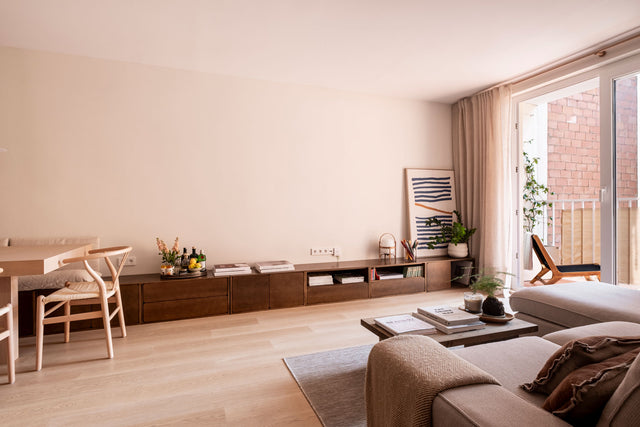
Natural materials regulate ambient humidity naturally, do not emit toxic volatile compounds, and age gracefully, gaining character over time. A solid wood TV stand made from sustainable oak or walnut will become an increasingly beautiful piece, while synthetic materials simply degrade.
Furthermore, when you choose sustainable materials, you're supporting production processes that respect natural cycles, protect forest ecosystems, and guarantee fair working conditions for everyone involved in the production chain. It's a form of conscious consumption that transforms your home into a healthier and more ethical space.

Sustainable wood as the main focus
Types of wood we use
In the Valencian carpentry workshops we collaborate with, we primarily work with three types of wood that stand out for both their beauty and sustainability: oak, walnut, and natural pine. Each offers unique characteristics that make them perfect for different pieces and decorative styles.
Oak is the undisputed star when you're looking for durability and strength. Its distinctive grain and warm tone make it the ideal material for Dining tables that will withstand the daily wear and tear of a family. It's a dense wood that resists impacts, temperature changes, and the passage of time without losing an ounce of its natural beauty.
Walnut, for its part, offers unparalleled elegance with its dark tones and smooth texture. It is perfect for Sideboards and pieces that you want to be the focal point of your living room. Their elegant character and silky-smooth finish make them a premium choice that justifies every euro spent.
Natural pine is our most versatile and affordable option without compromising on sustainability. It's a faster-growing wood, making it more renewable, but that doesn't mean it's any less durable. With the right treatments, a piece of pine furniture can last a lifetime, and its light tone brings brightness to any space.

Forest certifications you should know about
Not all wood is equally sustainable, even though it comes from trees. Forest certifications are your guarantee that the wood you buy comes from responsibly managed forests. The two main ones to look for are FSC (Forest Stewardship Council) and PEFC (Programme for the Endorsement of Forest Certification).
These certifications ensure that for every tree felled, another is planted, that forest biodiversity is respected, that workers are not exploited, and that the entire supply chain is monitored. When you see a piece of furniture with FSC or PEFC certification, you know you are contributing to the conservation of the planet's forests.
In our case, we work exclusively with suppliers who can demonstrate the traceability of every piece of wood. This is not only important for the environment, but it also guarantees the quality of the material. Well-managed forests produce higher-quality wood because the trees grow in optimal conditions.
The natural drying and treatment process
Once the certified wood has been selected, a crucial process begins that many people are unaware of: drying. Freshly cut wood contains a lot of moisture that must be gradually removed to prevent the furniture from warping or cracking over time. This process can take several months and requires patience and expertise.
In Valencia's artisanal woodworking workshops, we prefer natural drying in controlled chambers to accelerated industrial processes. It's slower, yes, but the result is a much more stable wood that will better withstand changes in temperature and humidity in your home.
After drying comes the finishing process. This is where we make a radical difference compared to industrial production. We use natural oils, vegetable waxes, and eco-friendly water-based varnishes instead of synthetic varnishes loaded with toxic solvents. These natural finishes allow the wood to breathe, enhance its natural grain, and don't release harmful compounds into your home.
The oils we apply penetrate the wood fibers, protecting it from within. They don't create that plastic film typical of industrial varnishes, but rather maintain the wood's natural, warm feel. And the best part is that they're easy to maintain: with a simple application every year or two, your The table will remain perfect for decades.
Eco-friendly lacquers and non-toxic finishes
One of our biggest concerns as manufacturers is the health of the people who will live with our furniture. That's why all our lacquers and finishes are completely non-toxic. We use water-based paints with ecological certifications that guarantee the absence of volatile organic compounds (VOCs) and other harmful substances.
Traditional lacquers can emit toxic gases for years after application. You've probably noticed that characteristic "new furniture" smell that gives you a headache. That's VOCs evaporating into the air you breathe. Our eco-friendly lacquers completely eliminate this problem.
Furthermore, the hand-lacquering process allows for complete control over the finish. Each chair or The headboard receives multiple thin layers applied with meticulous craftsmanship, gently sanded between each layer. The result is a silky, uniform, and durable finish that you could never achieve with automated industrial processes.
The color palette we can achieve with eco-friendly lacquers is practically endless. From pure Nordic whites to earth tones, soft grays, or even bolder colors if your project requires it. And all this without compromising on sustainability or your family's health.

Natural fibers and complementary materials
Sustainability doesn't end with wood. In the manufacture of complete furniture pieces, we use a variety of complementary materials that must also meet our ecological standards. Natural fibers such as rattan, wicker, and cane play a leading role in many of our pieces.
Rattan is a renewable tropical fiber that grows wild and regenerates quickly. We use it for furniture doors, headboards, and more. Dining chairs and decorative items. Its organic texture provides warmth and visual lightness, as well as being incredibly durable.
French cane weaving, meanwhile, is a traditional fabric making a strong comeback in contemporary design. Made with hand-woven natural fibers, it allows air to circulate, making it perfect for wardrobe doors and chair backs. Each piece of cane weaving is unique and adds a distinctive handcrafted touch.
For headboard and chair upholstery, we exclusively use certified fabrics with non-toxic treatments. We prioritize natural fibers such as linen, organic cotton, or technical blends that offer durability without the use of harsh chemicals. The fillings are made of high-density, CFC-free foam with certifications that guarantee their durability and safety.
Even in small elements like legs or fittings, we look for sustainable options. We use recycled metals when necessary, and all adhesives and glues are water-based, without formaldehyde or other problematic compounds.
Locally manufactured in Valencia
The importance of kilometer zero
When I tell you that our furniture is made in carpentry workshops in Valencia, it's not just a marketing ploy. It's a conscious decision that drastically reduces the carbon footprint of each piece. Think about the journey a piece of furniture made in Asia takes: by ship for weeks, by truck to the warehouse, then another van to your home. Thousands of kilometers emitting CO2.
Our furniture travels, at most, a few kilometers from our workshop in Yecla, Alaquàs, or the area around Valencia to your home. This proximity is not only good for the planet, but it also translates into shorter delivery times, better quality control, and the possibility of personalizing every detail with you before we begin manufacturing.

The zero kilometer mark also means support for the local economy. Every Each shelving unit produced in our workshops generates dignified employment in Valencia, keeps the artisanal knowledge of master cabinetmakers alive, and strengthens the productive fabric of our region. It's a form of consumption that directly benefits your community.
The value of Valencian craftsmanship
Valencia has a long tradition of cabinetmaking and carpentry that dates back centuries. The artisans we collaborate with are heirs to this accumulated knowledge, but they also incorporate modern techniques and contemporary designs. This combination of tradition and innovation is what makes our furniture special.
When you visit our showroom at Avenida Pérez Galdós 127 in Valencia, you can see and feel the difference that handcrafted work makes. Every joint, every finish, every detail is conceived and executed by hand by professionals who have spent decades perfecting their craft. It's not mass production; it's artisanal creation.
This level of dedication is evident in the furniture's ultimate durability. Properly glued and assembled joints will last for decades without loosening. The hand-lacquered finishes won't chip at the first bump. The drawers glide smoothly because they are precisely fitted. These are details that only handcrafted work can guarantee.
Furthermore, keeping the craft of woodworking alive is culturally important. We are preserving traditional techniques that could be lost in the age of mass production. Every young carpenter trained in these workshops is a guardian of that intangible heritage that defines our identity as a region.

Realistic and sustainable manufacturing times
One of the things our customers value most is our honesty regarding delivery times. We don't promise 48-hour delivery because handcrafted quality takes time. From the moment you confirm your order until the furniture arrives at your home, it can take between 3 and 6 weeks, depending on the type of piece and the level of customization.
This time isn't a drawback, it's a guarantee. It means your furniture is being made specifically for you, with properly dried wood, and all lacquering and drying processes are followed meticulously, without any rush that might compromise the final result. It's the time a quality piece needs to be born right.
During this period, we keep in touch with you. We'll let you know when manufacturing begins, when it's in the finishing stages, and when it's shipped to your home. And the delivery is special: Slowdeco furniture arrives fully assembled. You simply need to put it in place—no complicated assembly instructions or loose parts. Ready to enjoy from the very first moment.
This way of working also allows us to produce limited stock, which avoids wasting unsold furniture. It's a more sustainable production method that adjusts to actual demand without generating surpluses that would end up in landfills.

Personalization
Custom design for your space
One of the great advantages of working with local carpenters is the ability to customize each piece of furniture to perfectly suit your space and needs. You don't have to settle for standard sizes that almost fit. We design the exact piece you need.
Do you have an awkward space under a staircase? We design a Auxiliary furniture that makes the most of every inch. Does your living room have a unique layout? We create a modular TV unit system that adapts perfectly to your wall dimensions. Need a dining table for a small space? We manufacture it with the exact measurements that allow you to move around comfortably.
The customization process begins with a conversation. You tell us what you need, what your space is like, and what style you're looking for. We ask for photos and measurements, and we can even do a video call to see the space in person. With all that information, we create a personalized sketch that shows you exactly how the furniture will look in your home.
This custom design service isn't a luxury reserved for ultra-expensive projects. It's accessible to anyone who wants furniture that truly works in their space. The price difference compared to standard sizes is minimal, but the added value is enormous.
Finishes and colors to suit your style
Beyond the dimensions, you can choose every aesthetic detail of your furniture. The type of wood, the finish (natural, oiled, lacquered), the exact color of the lacquer, the type of doors (solid, mesh, rattan), the leg design, the interior layout of drawers and shelves... The possibilities are practically endless.
If you like light Nordic tones, we can work with natural oiled oak or white lacquered pine. If you prefer warmer, more inviting spaces, walnut with a natural finish or lacquered in earth tones is perfect. Looking for something bolder? We can also incorporate colors like deep greens, soft blues, or contemporary grays.
The key is to create a piece of furniture that reflects your personality and blends harmoniously with the rest of your décor. That's why, before we begin manufacturing, we send you samples of woods and lacquers so you can see them in your own home, in natural light. Colors change significantly depending on the lighting, and we want you to be completely confident before giving the go-ahead to production.
Modular systems that evolve with you
Modular systems are our answer to real life, which changes and evolves. Perhaps you need a 160 cm TV unit now, but in a few years you move to a larger house and need to expand it to 240 cm. With our modular systems, you simply add the modules you need.
This modularity has enormous sustainable value. It means you don't have to throw away the furniture and buy a new one when your needs change. You simply expand it, reconfigure it, or even transform it into a different piece of furniture. It's the antithesis of throwaway consumerism.
Modular systems also allow you to invest gradually. You can start with a basic configuration and expand it little by little according to your budget. All modules are designed to fit together perfectly, with the same finishes and quality, regardless of when you buy them.
This flexibility is especially valuable in fully customized projects. Imagine you design a complete storage system for your living room, but for now, you only install part of it. The rest of the design is saved in our files, and when you're ready, we manufacture the remainder, ensuring a perfect fit.

Durability versus planned obsolescence
One of the biggest problems in the furniture industry today is planned obsolescence. Furniture designed to last only until the warranty expires, made with cheap materials that deteriorate quickly, forcing you to buy again. It's an unsustainable business model, both economically and environmentally.
Our approach is the opposite. We make furniture to last a lifetime and, if possible, to be passed down to your children. This is no exaggeration: a well-made piece of solid wood furniture can easily last over 50 years with heavy use. Think of your grandparents' antique furniture that's still in perfect condition.
Durability depends not only on the materials but also on the construction. Traditional woodworking joints (mortise and tenon, dovetail) are infinitely stronger than screws and particleboard. Drawers with properly adjusted wooden runners will run smoothly for decades without needing replacements.
Furthermore, we offer genuine after-sales service. If your furniture needs a touch-up with use, we'll send you whatever you need to fix it. A bottle of oil to refresh the finish, a lacquer touch-up for a scratch, even replacement parts if something breaks accidentally. We want your investment to stay perfect for generations.
This commitment to durability means that, although the initial price may seem higher than that of industrial furniture, the long-term cost per year of use is much lower. It's a smart investment that also saves you the trouble of searching for and buying new furniture every few years.

How to care for your sustainable furniture
Natural wood maintenance
Natural wood is a living material that requires simple but consistent care. Basic maintenance consists of regularly cleaning with a slightly damp cloth, without using harsh chemicals that could damage the natural finish. Always dry completely after cleaning.
For oiled wood, we recommend applying a coat of furniture oil every 6-12 months, depending on usage. This treatment keeps the wood hydrated, enhances its natural grain, and strengthens its protection. It's a simple process you can do yourself in under half an hour.
Lacquered wood requires even less maintenance. Its protective finish is very durable; you only need to clean it regularly to keep it looking its best. If the lacquer loses its shine over time, a polish specifically designed for water-based lacquers will easily restore it.
Protect your furniture from intense, direct sunlight, which can discolor the wood over time. Use placemats or trivets to prevent heat marks on the surfaces. And control the humidity: an overly dry environment can cause the wood to shrink and crack, while excessive humidity can cause it to swell.

Simple repairs you can do yourself
With quality furniture, minor repairs are surprisingly easy. A superficial scratch on natural wood can be concealed with a touch-up marker in the appropriate shade or even with a walnut (its oil fills the scratch and darkens the area). For lacquered wood, there are specific touch-up paints available.
If a drawer starts to rub or doesn't slide smoothly, it's usually a matter of adjusting or replacing the runners. In our furniture, the runners are easily accessible and simple to replace. We'll send you the parts and a simple tutorial so you can do it yourself, although you can always request technical service if you prefer.
The hinges can be adjusted with a simple screwdriver so the doors close perfectly again. This is preventative maintenance we recommend doing once a year. And if any hinge wears out from heavy use, they are standard components that are easy to find and replace.
For stubborn stains on upholstery, act quickly. Absorb the liquid without rubbing, use water with mild soap to clean, and let it air dry. Upholstery with a stain-resistant treatment is much more resistant, but even untreated natural fabrics can be cleaned effectively if you act promptly.
The future of sustainable furniture
The trend towards sustainability in the furniture sector is not a passing fad; it's the inevitable future. Consumers are increasingly aware of the environmental and social impact of their purchasing decisions. They seek transparency, traceability, and genuine values, not just pretty words on a website.
Newer generations particularly value the circular economy. They prefer to invest in durable pieces that can be repaired, upgraded, or even transformed, rather than buying disposable furniture. This shift in mindset is pushing the entire industry toward more sustainable processes.
Technology also plays a role. Digital design tools allow us to create precise, custom sketches, reducing errors and waste. CNC cutting systems optimize the use of each piece of wood. But technology should serve the craftsman, not replace him.
Innovative materials also open up new possibilities. Thermally modified woods that improve durability without chemicals, increasingly strong plant-based adhesives, and natural finishes with superior technical performance. The future combines the best of tradition with scientific advances.
Outcome
Choosing furniture made with sustainable materials in local workshops in Valencia isn't just a purchase decision; it's a way of positioning yourself in the world. You're choosing quality over quantity, durability over disposable items, and local products over anonymous global ones.
Each TV cabinet , each chair , each Each sideboard that leaves our workshops bears the mark of the care of the artisans who crafted it, the sustainability of the chosen materials, and the personalization that makes it a unique piece for your home. It's not just another product; it's an investment in quality of life.
Sustainable materials ensure your home is a healthy, toxin-free space, where natural wood regulates humidity and ages with character. Local manufacturing drastically reduces your carbon footprint and supports artisans in your region. And customization allows you to have exactly the furniture you need, without compromise.
If you visit our showroom in Valencia, you'll experience the difference firsthand, feel the warmth of natural wood, see the handcrafted finishes up close, and understand why these pieces are worth every penny. It's not marketing; it's Valencian craftsmanship at the service of your home and the planet.
The future of furniture is sustainable, local, personalized, and durable. Not because it's a design trend, but because it's the only sensible way to furnish our homes in the 21st century. And that future is already here, in the carpentry workshops of Valencia that work every day to create pieces that will last a lifetime.
0 Comments
There are no comments for this article. Be the first one to leave a message!