

TV furniture with storage: Combining functionality and style
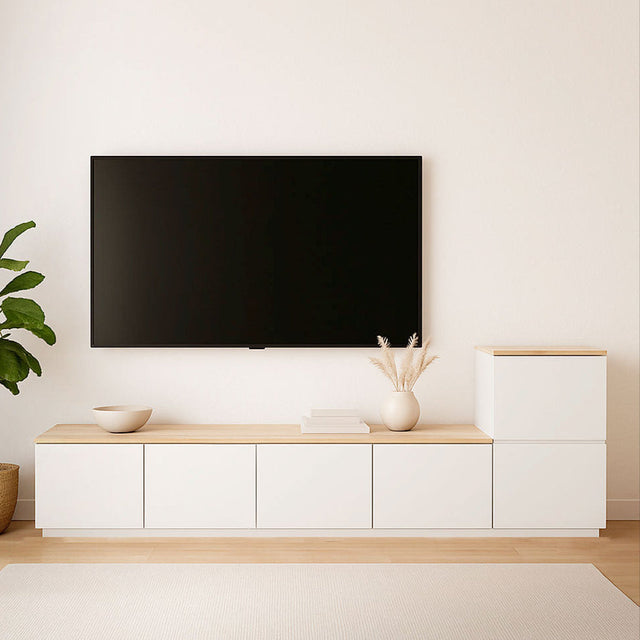
You've noticed your living room is a mess, cables are piling up behind the TV, and you don't know where to put the remotes, game consoles, or those books that never seem to find a place. You're not alone. The heart of your home, the space where you share family moments and enjoy your favorite shows, deserves more than just a TV stand. You need a piece of furniture that works with you, that brings order to your life without sacrificing the style you love.
TV units with storage represent that smart solution that combines practical functionality with thoughtful design. It's not just about having a place to put your television, but about creating an organized system that transforms your living room into a harmonious space, where everything has its place and where aesthetics and order coexist effortlessly. Throughout this article, I'll share everything I've learned after years of working with furniture and helping families find that perfect piece that makes all the difference in their home.
Why storage makes a difference in your living room
When you walk into a room and feel that sense of peace, that everything is in its place, it's rarely by chance. Behind that ambiance are conscious decisions about storage. I'm going to tell you something I've observed in hundreds of homes: visual clutter generates stress, even if you're not always aware of it. Your brain processes everything it sees, and when there are scattered objects, tangled cables, or DVDs piled haphazardly, your mind never truly rests.
A A well-designed wooden TV unit with storage works wonders: it creates a tidy focal point that visually anchors the entire room. Instead of multiple items vying for your attention, you have a cohesive composition where everything has its designated space. Drawers conceal items you don't need to see constantly, open compartments display your favorite decorative objects, and cable management keeps all your tech connected without making it look like a snake pit.

The difference between a functional living room and a frustrating one lies in the storage details. How many times have you desperately searched for the remote control? Or had to unplug three cables to connect a new device? A smart storage system anticipates these everyday situations and resolves them before they become a nuisance.
Furthermore, well-planned storage has an economic impact that many people overlook. When you have designated spaces for your belongings, you stop buying duplicates because "I can't find the other one." You better protect your electronic devices from bumps and dust. And most importantly, you invest once in a quality piece of furniture that will grow with you, instead of accumulating piecemeal solutions that never quite work.
Size matters: find your perfect fit
Let's talk about a mistake I see constantly: choosing a TV stand because it's pretty, without considering whether the dimensions will actually work in your space. Measurements aren't just a boring technical detail; they're the difference between a living room that flows naturally and one where everything feels forced.
Let's start with the basics: the width rule. Your A 150cm TV stand should always be wider than your television, ideally by 15 to 30 centimeters on each side. This isn't just about aesthetics; it's about visual balance. When the television protrudes from the stand, it creates a feeling of instability that your brain subconsciously registers. On the other hand, an excessively wide stand can make the television look lost, although this is less common.

Depth is another crucial aspect that many people underestimate. A cabinet with a depth of 45-50 cm gives you enough space for audiovisual equipment, cables running behind it, and a safety margin. If you opt for a For a floating TV unit , depth becomes even more important because you need to distribute the weight correctly and ensure that all connectors are accessible without the unit protruding too much from the wall.
The ideal height varies depending on your setup. If you're watching TV from the sofa, the center of the screen should be at eye level when you're seated, approximately 90 to 120 cm from the floor. This means that a 40-50 cm high TV stand works for most medium-sized televisions. For larger screens, you'll need to adjust this measurement.
For spacious areas looking to create a true entertainment center, a A 250cm TV unit offers spectacular possibilities. These large-format units not only support televisions up to 85-98 inches, but also provide massive storage without sacrificing visual proportions. They are perfect when you want the TV unit to be the focal point of the living room, creating a monumental composition that organizes all your entertainment into a single, integrated system.

Don't forget to measure the circulation space as well. You need at least 80-90 cm between the furniture and the sofa to move around comfortably. If your living room has a complex layout, make a scale plan before deciding. A trick I recommend: use masking tape on the floor to mark the dimensions of the furniture you're considering. Live with those markings for a few days, walk around, and observe how they affect the flow of the space. This simple exercise will save you from decisions you'll regret.
Storage types that transform your everyday experience
Now comes the really interesting part: the different storage systems and how each one addresses specific needs. After working with so many families, I've learned that there's no single perfect system, but rather smart combinations that adapt to your lifestyle.
Deep drawers are your best allies for invisible organization. That's where you put remote controls, spare cables, instruction manuals you keep "just in case," chargers, batteries... that whole ecosystem of small objects you need to have close by but don't want to see. A well-designed TV unit with storage includes at least two drawers with soft-close runners. This soft-close feature isn't a luxury; it's pure functionality: it prevents slamming, protects the contents, and adds that feeling of quality you notice every time you use it.

Open shelving serves a completely different purpose. It's a space where you can showcase your personality: books, plants, travel souvenirs, that vinyl record collection, framed photographs. But be careful: open shelving requires discipline. If you tend to be clutter-prone, limit the open areas and prioritize closed storage. If you're naturally organized, open shelving adds visual lightness and allows you to change the decor according to the season or your mood.
Cabinets with doors are perfect for audiovisual equipment that generates heat: the Blu-ray player, the video game console, the amplifier. But here's an important technical detail that many people discover too late: you need ventilation. Look for Designer TV stands that include ventilation slots on the back or sides are essential. Electronic devices need air circulation to prevent overheating, especially when they are all concentrated in a confined space.
Asymmetrical combinations are gaining popularity, and for good reason. A design that combines drawers on one side with open shelving on the other creates visual interest while optimizing functionality. You can conceal practical items and display decorative ones in the same piece of furniture, achieving that balance between order and personality that makes a living room truly feel like your own.
If you work with small spaces or want to maximize every inch, consider a modular system. The Nolla TV unit is a perfect example of this philosophy: modules that you can configure according to your exact needs, with options to place them on the floor, hang them on the wall, or mount them on legs. This flexibility means the unit can evolve with you: today you might need more closed storage because you have young children, but in a few years you might prefer more display space.

The cable management system you need to know about
Let me be blunt: if your solution for cables is "hiding them behind the furniture as best you can," you're creating future problems for yourself. I've seen situations where connecting a simple new device required moving the entire piece of furniture, unplugging everything, and starting from scratch. It doesn't have to be that way.
The Modern white TV units include integrated cable management systems, but you need to know how to use them effectively. The concept is simple: route all cables along specific paths that keep them organized, accessible, and, most importantly, invisible from your normal viewing perspective.
Start with the rear cable grommet. This hole in the back of the cabinet isn't there by chance: it's the single entry point for all your power and signal cables. Bundle the cables together with reusable cable ties, not adhesive tape that leaves residue. Each device should have its cables bundled separately and labeled with tape or markers. Yes, this initial step takes time, but it will save you hours of frustration down the road.
Inside the cabinet, use adhesive cable organizers that you can stick to the internal walls. These small clips direct the cables exactly where you need them, preventing them from getting tangled. For cables you need to access frequently, such as the controller charger or occasionally used HDMI cables, leave some slack instead of pulling them taut.
A pro tip: always keep one or two spare HDMI cables coiled and labeled inside your entertainment center. When you have guests and someone wants to plug in their laptop, or when you buy a new device, you won't have to dig through the back of the cabinet. This simple precaution makes your entertainment system much more flexible.
For power strips, choose models with generous spacing between outlets. Bulky transformers are the norm, not the exception, and a cheap power strip with outlets too close together will force you to use multiple strips, unnecessarily complicating the system. Invest in a good power strip with surge protection, securely mount it inside your cabinet, and you'll have a tidy and protected central power outlet.
Materials and finishes that define your style
The material of your TV stand isn't just an aesthetic choice; it's a statement about how you want to live with it. Each material tells a different story and comes with its own practical advantages.
Solid wood is the material we primarily work with at Slowdeco, and there are compelling reasons for this. Oak furniture has a presence that you simply can't replicate with processed materials. Every grain is unique, meaning your piece is literally one-of-a-kind. Over time, the wood develops a natural patina that adds character rather than looking worn. I've seen 20-year-old oak furniture that looks more beautiful than when it came out of the workshop—something impossible with laminated materials.

Walnut deserves special mention for its stylistic versatility. Its dark, warm tones work equally well in contemporary and more classic settings. If you're looking to create a focal point with immediate presence, walnut is your ally. Furthermore, its natural hardness makes it extremely resistant to everyday wear and tear: superficial scratches, minor bumps—the daily treatment that the most used piece of furniture in the house inevitably receives.
White finishes offer something completely different: brightness and a feeling of spaciousness. A hand-lacquered white TV unit reflects natural light, making the living room appear larger and more airy. They work especially well in small spaces or rooms with little natural light. But here's an important point: not all whites are created equal. Pure white creates dramatic contrast, while off-white or antique white adds warmth and blends better with natural elements.
Material combinations are gaining popularity, and for good reason. Imagine a piece of furniture in natural oak with white lacquered doors, or metal details that add an industrial touch. These mixes create visual depth and allow the furniture to interact with different elements of your decor. A rattan or mesh detail on the doors, for example, adds texture and allows for natural ventilation for your electronic devices.
Natural finishes with eco-friendly oils and waxes are not just an aesthetic or ethical choice, they're a practical one. These treatments respect the wood's natural porosity, allowing it to "breathe." This is especially important for a TV stand, where electronic devices generate heat. Furthermore, natural finishes are repairable: a scratch on oiled wood can be treated locally without needing to replace the entire piece.

How to adapt storage to your specific devices
Every home has its own technological ecosystem, and your TV unit needs to adapt to it. Storing equipment for a die-hard film buff is not the same as storing it for a family with young children who mainly use streaming services.
If you're a gamer, your needs are very specific. Modern consoles require ample ventilation, easy access for frequent disc changes, and space to store physical games and extra controllers. Look for setups with at least one open compartment where the console can breathe freely, nearby power outlets, and enough vertical space so you don't have to tilt it. Modular TV furniture offers the flexibility to dedicate an entire section to gaming while keeping the rest of the space for other uses.
Home theater enthusiasts have different requirements. A surround sound system means multiple speakers that need specific placement, an amplifier that generates considerable heat, and probably a physical collection of movies. For this user, prioritize interior height in amplifier compartments, multiple cable outlets for distributing speakers, and ample enclosed storage with doors for hundreds of discs. One detail that makes all the difference: adjustable shelves that you can reconfigure as your collection grows.
For families with young children, safety and practicality go hand in hand. Soft-close drawer systems prevent pinched fingers, rounded edges ensure robust stability, and, crucially, wall fixings are included. Children climb—that's a fact. Your The TV unit needs to be securely anchored, especially if you choose a floating design or one with high legs. Also, consider low shelves where children can safely access their toys and remote controls, encouraging their independence within safe limits.
Minimalists who only use streaming have it easy in terms of storage, but equally important in terms of design. With fewer devices, you can opt for clean lines, almost entirely hidden storage, and showcase decorative elements instead of technology. A single, discreet compartment for the router, soundbar, and power strip can be sufficient, leaving the rest of the cabinet to create a visual composition that reflects your personality beyond the technology itself.
Integrating the TV unit into different decorative styles
This is where theory meets the practice of your real home. You've decided on the dimensions, the storage, the materials... but how do you make all of this blend harmoniously with your existing style?
The Nordic style, with its emphasis on functionality, clean lines, and natural materials, is the natural territory for our designs. Nordic TV units are characterized by simple shapes without excessive ornamentation, light woods such as natural oak or pine, and a neutral color palette where white plays a leading role. The key is balance: enough storage to maintain order (essential in Nordic design) without creating a visually heavy piece.

To integrate a piece of Nordic-style furniture, surround it with elements that share the same aesthetic: textiles in natural tones, natural fiber baskets for extra organization, plants that add life without complicating the composition, and warm lighting that softens the furniture's straight lines. The result should feel welcoming yet tidy, functional yet beautiful.
The Mediterranean style calls for a different approach. Here, off-whites and aged tones work better than pure whites, creating that feeling of a piece that's been there forever. Combine your A white TV unit with distressed wood elements, handcrafted ceramics, and textiles in shades of blue and sea green. Imperfection is part of the charm: an overly perfect finish seems out of place in an authentic Mediterranean setting.
For industrial spaces, look for designs with metal elements, dark finishes, or combinations of raw wood and steel. A walnut cabinet with a black metal frame fits perfectly into this style, especially if you incorporate integrated LED lighting, which adds that characteristic technical touch of industrial design. Open compartments work particularly well here, showcasing your tech equipment as part of the aesthetic rather than hiding it.
Contemporary style gives you maximum freedom to experiment. Asymmetrical lines, unexpected combinations of materials, bold colors complementing neutral bases... A contemporary TV unit can be the focal point that defines the entire space, so don't be afraid to be bold. However, make sure functionality isn't sacrificed for aesthetics. A beautiful but impractical piece of furniture will ultimately be frustrating, no matter how attractive it is.
Sustainability as part of real value
When we talk about furniture, especially a central piece like a TV unit, sustainability isn't an optional extra or a marketing ploy. It's a fundamental decision that affects the real and lasting value of your investment.
The furniture we make in our carpentry workshops in Valencia uses wood from sustainably managed forests. This means that for every tree felled, several more are planted, maintaining the ecological balance. FSC or PEFC certifications guarantee that the wood comes from responsible sources. But beyond certifications, there's something profoundly logical about choosing local wood: you reduce unnecessary transport, support your region's economy, and have complete traceability of the material.
The eco-friendly finishes we use—natural oils and waxes—eliminate the VOCs (volatile organic compounds) found in synthetic varnishes. These chemicals not only harm the environment during manufacturing but continue to be released into your home for years. A natural finish means cleaner air in your living room, which is especially important if you have children or pets who spend a lot of time near the furniture.
Durability is the most underrated aspect of sustainability. A handcrafted piece of solid wood furniture can literally last for generations. Compare this to particleboard or MDF furniture, which, even with careful handling, rarely lasts more than 10 years before showing irreparable wear. By choosing lasting quality, you dramatically reduce your long-term environmental impact. It's simple math: one piece of furniture that lasts 50 years versus five pieces that last 10 years each.
Furthermore, wooden furniture is repairable. A scratch, a stain, a small dent... all of these can be treated without needing to replace the entire piece. We provide maintenance kits specifically designed for each type of wood and finish. This repairability extends the lifespan of the furniture and reduces waste.
Handcrafted production in local workshops has another sustainable advantage: each piece of furniture is made to order, eliminating mass overproduction and the resulting waste. There are no giant warehouses full of furniture waiting for buyers, no shipping from the other side of the world, and no intermediaries adding carbon footprints without adding value.

The art of organizing the space around the TV unit
Your TV unit doesn't exist in isolation; it's the anchor of the entire spatial composition. The way you organize the environment determines whether the living room functions as a cohesive space or feels fragmented and chaotic.
The rule of the visual triangle is fundamental: your gaze should be able to comfortably travel along a triangle formed by the television, the seating area, and a third decorative focal point. This third element could be a large plant, a side shelf, a work of art—anything that balances the presence of the TV unit and prevents all attention from being focused solely on the screen.
The optimal viewing distance is approximately 1.5 to 2.5 times the width of your television. For a 55-inch screen, this translates to 2 to 3 meters. This distance isn't arbitrary: it allows your eyes to take in the entire image without moving your head, reducing eye strain. If your living room is small and you can't achieve this distance, consider a slightly smaller television and use the extra space on the furniture for decorative items that enhance the ambiance.
The lighting around the TV unit deserves special attention. Avoid direct light that reflects off the screen, but ensure sufficient ambient lighting. An LED strip behind the television, known as bias lighting, reduces eye strain by creating a soft halo of light. Complement this with floor or table lamps that illuminate other areas of the room, preventing all the light from coming from the screen.
Decorative items on or around furniture should follow the odd-numbers rule: three objects work visually better than two or four. Vary heights, textures, and shapes to create interest without creating chaos. A tall plant, a set of books, and a medium-sized decorative object create a more interesting composition than three objects of the same size.
If you have the side space, consider adding vertical elements to balance the horizontality of the TV unit. A tall bookshelf, a raised potted plant, or even a decorative panel can create that sense of a complete composition that transforms an isolated piece of furniture into the cohesive centerpiece of the living room.
Maximizing space in small rooms
Small spaces present unique challenges, but they also offer creative opportunities that larger rooms don't. In a small room, every decision counts twice as much.
The Floating TV units are your best allies in compact spaces. By hanging the unit, you free up visual and physical floor space, creating an immediate feeling of spaciousness. The area under the unit can be used for decorative baskets with additional storage, for a robot vacuum cleaner, or simply left empty, making the room appear larger than it is.
The installation height of a floating TV in small spaces requires careful calculation. Too high and it visually dominates the room; too low and you lose that feeling of spaciousness you're looking for. As a general rule, the center of the TV should be 90-110 cm from the floor when you're sitting in your usual viewing position.
Vertical storage solutions make better use of space in small living rooms. Instead of a long, low piece of furniture, consider designs that incorporate height. Stackable modules, integrated side shelves, or back panels with additional storage multiply capacity without taking up more floor space. Nolla TV furniture offers vertical configurations specially designed to maximize storage in limited spaces.
Light colors are your allies. White or light wood furniture reflects light and doesn't visually overwhelm the space. Combine it with walls in similarly light tones to create visual continuity that makes the room feel larger.
Multifunctional solutions are especially valuable in small spaces. A TV unit that incorporates a side desk, or that can be closed to completely conceal the television when not in use, doubles the functionality without doubling the space occupied. Look for modular designs that evolve with your needs: today you might need more media storage, but tomorrow you can reconfigure the modules for other uses.
The key to small spaces is disciplined storage. You can't afford cluttered surfaces, so prioritize furniture with plenty of closed storage. What's out of sight doesn't visually overwhelm the space, and in a small living room, this makes a world of difference to how the room feels.
Current trends in TV furniture with storage
Furniture design is constantly evolving, responding to changes in our lifestyles and aesthetic expectations. Let's see what's shaping the current landscape.
Asymmetrical designs are gaining significant popularity. Tired of perfectly symmetrical compositions that can feel predictable, many people are now looking for furniture with an asymmetrical layout. One side might have stacked drawers while the other features staggered open shelving. This asymmetry adds visual dynamism and, interestingly, allows the furniture to better adapt to the irregular architecture found in many real homes.

Unprocessed natural materials are booming. Woods with visible knots, pronounced grain, and small irregularities that were once considered "defects" are now valued as signs of authenticity. This trend reflects a widespread weariness with industrial perfection and a desire for connection with the genuine. Solid wood furniture that showcases its natural origin tells a story that resonates emotionally.
Integrated LED lighting is becoming standard rather than optional. LED strips under shelves illuminate the contents, interior lights in display cases, ambient backlighting... integrated lighting not only adds practical functionality for movie nights, but also allows you to create customized atmospheres depending on the time of day or activity.
Modular, configurable systems represent perhaps the most significant trend. People no longer want to commit to a fixed configuration for the next 20 years. They want furniture that can grow, change, and adapt as their lives evolve. Modules that you can add, rearrange, or reconfigure offer the flexibility that the modern world demands.
Matte finishes are replacing glossy ones. While glossy lacquers dominated the market a decade ago, today matte and satin surfaces are preferred for their ability to hide fingerprints, their more natural appearance, and their smoother integration into diverse environments. This shift reflects a search for authenticity over attention-grabbing.
Hidden storage solutions are reaching new levels of sophistication. Handleless drawers that open with a gentle touch, secret compartments behind decorative panels, motorized lift systems that conceal the television when not in use... technology is making storage virtually invisible until the exact moment you need it.
Maintenance that preserves beauty for decades
A quality piece of furniture is an investment, and like any investment, it requires proper care to maintain its value and beauty. The good news is that this care is simpler than you might think.
For daily cleaning of natural wood, a slightly damp microfiber cloth is all you need. No harsh chemicals, no generic all-purpose cleaners. Pure water removes dust without damaging the natural oils that protect the wood. Dry immediately with a dry cloth to prevent moisture absorption.
Periodic maintenance depends on the type of finish. For oiled woods, an application of a specific oil every 6-12 months revitalizes the protection and maintains the wood's warm tone. The process is simple: thoroughly clean the surface, apply the oil with a soft cloth in the direction of the grain, let it absorb for 15-20 minutes, and remove any excess. Your furniture will remain nourished and protected for months to come.
Lacquered finishes require less active maintenance but more preventative care. Avoid placing very hot objects directly on the surface, use coasters for drinks, and clean up spills immediately. Water stains are the number one enemy of lacquered surfaces: if you leave a condensation ring from a glass, you can end up with a permanent mark.
For For white furniture , preventing yellowing is crucial. Avoid prolonged exposure to direct sunlight. If your living room receives a lot of natural light, consider curtains or blinds that you can adjust during peak hours. Quality white finishes include UV protection, but even these have their limitations.
You can easily do minor repairs yourself using the kits we provide. A superficial scratch on natural wood can be treated with a touch of oil or wax in the same shade. Deeper dents may require wood filler, which is then lightly sanded and finished accordingly. These localized repairs are one of the great advantages of solid wood over processed materials that don't allow for this type of intervention.
Preventing structural damage starts with proper assembly. If your furniture is floating, check annually that the wall fixings are still securely anchored. If it has legs, make sure the levelers are properly adjusted and that there are no imbalances that could cause stress. A well-installed piece of furniture is a piece of furniture that will last without problems.

Common mistakes to avoid when choosing your furniture
After years of helping people find their ideal furniture, I've seen some mistakes repeated time and again. Knowing them will save you disappointment and money.
The most common mistake is buying the TV stand before deciding what kind of TV you'll get. The logical order is TV first, then stand. The TV's dimensions determine the proportions your stand needs. I've seen people buy a beautiful stand only to discover later that their TV sticks out the sides or, even worse, that the central compartment isn't tall enough.
Underestimating storage needs is another classic mistake. You think, "I only need space for the set-top box and the soundbar." But then there are the controllers, the cables, the chargers, that external hard drive, the game console you "almost never use" but there it is, your reading glasses, the book you're reading... Real life is more complex than our idealized vision. Always, always overestimate your storage needs. I've never heard anyone complain about having too much storage space, but I constantly hear the opposite.
Ignoring ventilation is a serious technical mistake. Modern electronic devices generate significant heat. A closed compartment without adequate ventilation can drastically reduce the lifespan of your equipment, as well as create potential safety hazards. If you're going to store equipment in enclosed spaces, make sure the cabinet has ventilation slots or, even better, a back panel with generous openings.
Choosing furniture based solely on a photograph is risky. Professional images are beautiful, but they don't tell you about the actual quality of the materials, the sturdiness of the construction, or how it feels to the touch. If possible, visit a showroom. If not, at least research the specific materials, read detailed descriptions, and look for reviews from other buyers.
Sacrificing quality for immediate price is perhaps the most costly mistake in the long run. A cheap piece of furniture that you need to replace every 5 years ends up being more expensive than a quality piece that lasts 30 years. Do the math: if you invest €800 in a A quality piece of furniture that lasts 30 years costs you €26 per year. A €200 piece of furniture that lasts 5 years costs €40 per year, not counting the hassle of having to find, buy, and replace it every five years.
Failing to consider future evolution is another common mistake. Your life will change, your technological needs will change, your family may grow. A rigid design that doesn't allow for adaptation will quickly become obsolete. Modular or configurable systems offer the flexibility to evolve with you—an investment in future peace of mind.
How smart storage improves your quality of life
Beyond the obvious functionality, a well-designed storage system has profound impacts on your daily well-being that are rarely discussed but that you constantly experience.
The mental stress of clutter is real and measurable. Neuroscience studies show that cluttered environments increase levels of cortisol, the stress hormone. When you come home after a long day and your living room is tidy, with everything in its place, your brain literally relaxes. A TV unit with well-organized storage directly contributes to this feeling of peace.

Time efficiency is another tangible benefit. Think about how many times you've desperately searched for the remote control, or had to unplug three cables to plug in a new one. These small frustrations add up, stealing your time and patience. A system where every item has its assigned and easily accessible place gives you back that time for things that truly matter.
The ability to enjoy your space increases dramatically. A tidy living room invites you to use it, to relax in it, to share quality time with family and friends. Clutter, on the other hand, generates that persistent feeling of "I should tidy this up" that prevents you from fully relaxing, even when you're trying to rest.
Family relationships improve, even if it seems exaggerated. Arguments about "who left this here" or "where is that" decrease when there are clear organizational systems. Children learn responsibility when they have specific places to store their belongings. Adults avoid tension when the shared environment is kept tidy without heroic effort.
The lifespan of your devices is extended when they are stored properly. Protected from bumps, dust, and excessive heat, your electronic equipment works better and lasts longer. It's an invisible form of saving: you're not spending money to replace things damaged by improper storage.
Customizing your furniture for unique needs
Every home is different, every family has its own unique characteristics, and the best furniture recognizes and embraces this diversity. Personalization isn't a luxury; it's the difference between a piece of furniture you use and a piece you love.
Custom dimensions are the first level of adaptation. Do you have that space between two walls that measures exactly 237 cm, and standard furniture comes in sizes of 200 or 250 cm? Custom-made furniture makes the most of every centimeter, eliminating awkward gaps and wasted space. At Slowdeco, we work with local carpenters who can adapt exact dimensions to your specific space, creating solutions that seem tailor-made for your home because they literally are.
Custom finishes allow the furniture to blend seamlessly with your existing décor. Perhaps you have oak floors but prefer lighter-toned furniture, or vice versa. Maybe your space calls for that specific shade of blue-gray you can't find in any standard catalog. The RAL color chart offers thousands of options, allowing the The Nolla TV unit integrates exactly as you envisioned it.

Custom storage configurations address your real needs. Do you have a large vinyl record collection that requires dedicated vertical storage? Do your children have dozens of video game consoles that need an organized system? Do you work from home and need to integrate a side desk? These are all modifications that transform a standard piece of furniture into your perfect solution.
Customized opening systems make all the difference in everyday use. Sliding doors instead of hinged ones if you have limited space in front of the cabinet, drawers with custom internal dividers to organize small items exactly how you use them, compartments with a hinged top for access from above... these details seem minor until you experience them day after day.
Solutions for special needs are another area where customization shines. Perhaps you need extra height in a compartment for specific equipment, or you require simultaneous front and rear access because the unit will serve as a room divider. Maybe you work with professional equipment that has non-standard dimensions. Handcrafted manufacturing allows for these adjustments that mass production could never offer.
The smart buying process: what to ask and what to check
Buying a quality TV stand is a significant investment, and like any major investment, it requires asking the right questions and checking the appropriate details.
Start by investigating the origin and manufacture. Where does the wood come from? Who makes the furniture? Furniture made in Valencia by local carpenters offers full traceability, verifiable quality, and supports the local economy. Ask specifically about wood sustainability certifications and the manufacturing process.
The exact materials matter more than you might think. "Wood" can mean anything from solid wood to veneered particleboard. "Lacquered" can refer to high-quality, multi-layered finishes or basic spray-applied paints. Ask for complete technical specifications: wood thickness, type of joints used, hanging system if floating, shelf load capacity, and the exact type of finish applied.
Warranties reflect the manufacturer's confidence in their product. Quality furniture comes with a comprehensive, multi-year warranty, covering not only manufacturing defects but also structural issues. Ask specifically what the warranty covers, how long it lasts, and what the procedure is if you need to use it.
Assembly and installation are crucial aspects that many people discover too late. Does the furniture arrive fully assembled or does it require further assembly? If it's a floating unit, does it include the complete wall mounting system? Are detailed instructions provided? At Slowdeco, our furniture arrives pre-assembled from the carpentry workshop, ready to place and enjoy, eliminating the stress and hours of frustration of home assembly.
After-sales support is what makes a good purchase stand out from an excellent one. What if you need a color touch-up after a bump or knock? What if a drawer needs adjusting after years of use? What if you want to add an extra module in the future? Companies that manufacture locally and build to last offer ongoing support, sending maintenance kits, providing personalized advice, and being available whenever questions arise.
Delivery times also deserve attention. Custom-made furniture requires time, generally between 4 and 8 weeks depending on the complexity. Be wary of promises of immediate delivery on supposedly personalized furniture; you're probably looking at prefabricated stock with limited customization. A reasonable waiting time is a sign of authentic and careful craftsmanship.
Real inspiration: configurations that work
Let's look at some concrete examples of configurations that solve real needs, to help you visualize how these principles translate into practical solutions.
The film buff with a family : needs massive storage for a collection of hundreds of movies, but also space for toys and children's books. Solution: a setup of 250cm TV unit with two-thirds dedicated to closed storage with adjustable shelves for movies and audiovisual equipment, and one-third with open compartments at a child's height where children can safely access their belongings. Soft-close doors for safety, and a back panel with ample cable management for a surround sound system.
Urban minimalism in a small space : a 45m² apartment where every centimeter counts. Solution: A 180cm matte white floating TV unit with fully enclosed storage except for a central compartment for a soundbar. The visual effect expands the space, while the concealed storage maintains a clean look. Textile baskets beneath the unit store blankets and magazines, making use of the space freed up by hanging the unit.
The gamer family : two current-gen consoles, one retro console, a collection of physical and digital games, multiple controllers, and accessories. Solution: a modular setup with a dedicated double-height module for the consoles with optimal ventilation, perforated side shelves for alphabetically organized games, deep drawers with custom interior dividers for controllers, and cables organized by system. All in one. natural wood with black metal details that create that gaming touch without being childish.
The hybrid home office professional : the living room must function as an entertainment space at night and a work area during the day. Solution: furniture... Modular design integrating a fold-down desktop section, mixed storage for entertainment technology and office supplies, and a cable management system that serves both work and leisure devices. Finished in light oak tones to maintain a professional yet welcoming atmosphere.
Lovers of Mediterranean design : they seek that balance between modern functionality and relaxed coastal aesthetics. Solution: A white TV unit with an aged finish, combined with rattan details on the doors for texture and natural ventilation. Open compartments display handcrafted ceramics and seashells collected on travels, while closed storage keeps technology discreet. The overall effect is airy without being cluttered.
The knot: what really matters in your decision
You've explored a wealth of information: dimensions, materials, styles, trends, customization... Now it's time to connect all of this with your specific situation. The purchase decision isn't just technical; it's equally emotional and practical.
Your TV stand will likely be the most used piece of furniture in your home. You'll interact with it daily for years, possibly decades. This frequency of use means that every design and functional detail we've discussed will be multiplied by hundreds or thousands of interactions. A smoothly opening drawer isn't a luxury when you open it three times a day for ten years; that's more than 10,000 pleasant experiences versus 10,000 minor frustrations.
Investing in quality is justified not only mathematically, but also emotionally. There's a profound pleasure in using well-made objects, in noticing the solidity of the wood, in appreciating the careful finish every time your hand touches a surface. This aesthetic and tactile pleasure enriches your daily life in subtle yet constant ways.
Sustainability isn't just an abstract environmental issue; it's a decision about the kind of world you want to live in and the values you want to pass on. When you choose a By purchasing locally made furniture using responsible materials, you're voting with your money for a more humane and conscious production model. Every purchase is a vote, and this particular vote has a visible and tangible impact.
Personalization reflects respect for your individuality. You deserve furniture that meets your specific needs, not furniture that forces you to adapt your life to its limitations. Artisan carpentry workshops that manufacture to order recognize that every home is unique and every family has its own way of living.
The space you inhabit is part of who you are. It's not just superficial decoration; it's the container of your daily life. An organized and beautiful living room isn't vanity; it's self-care. It's creating an environment that sustains you instead of exhausting you, that energizes you instead of draining you.
Outcome: Your next step towards the salon you deserve
We've reached the end of this journey, but for you, it's truly a beginning. You now have the tools to make an informed decision, to choose not just a beautiful piece of furniture, but a complete solution that will transform your everyday home experience.
The process begins with honesty about your true needs. Observe how you currently use your living room, what frustrates you, and what you're missing. Measure your space precisely, not approximately. Take photos from different angles to have a visual reference when comparing options. This initial preparation will save you from misunderstandings and disappointments later on.
Visit our Visit our showroom in Valencia if possible. Photographs convey design, but they don't transmit the tactile quality of solid wood, the smooth closing of drawers, or the sturdiness of the construction. Seeing and touching real furniture will give you concrete references that images can never fully provide. If you can't visit us in person, request samples of materials and finishes to evaluate them in your own light, in your own space.
Explore the options of Customization options available . Don't settle for something almost perfect when you can have exactly what you need. The customization process includes professional advice, visual proposals, and attention to every detail to ensure the final result exceeds your expectations.
Consider your TV unit as part of a larger home ecosystem. How does it interact with your shelves , with your Sideboards , with the rest of your furniture? Stylistic coherence doesn't mean that everything is identical, but rather that there is a common language that creates visual harmony in your space.
Think long-term. You're choosing something that will be with you for years, that will see your children grow up if you have them, that will witness countless movie nights, TV marathons, and family celebrations. This long-term perspective justifies investing in real quality, in handcrafted manufacturing, in sustainable materials that age gracefully.
Investing in a quality TV unit with smart storage isn't an expense; it's a tangible improvement to your everyday life. It eliminates daily frustrations, creates effortless order, and allows you to enjoy beauty every time you enter your living room. It supports local craftsmanship and sustainable production. It's consciously choosing the kind of home you want.
Your salon deserves more than a temporary fix or a mediocre compromise. It deserves a A TV unit that combines impeccable functionality with conscious design, as practical as it is beautiful, as durable as it is sustainable. This combination exists, crafted with meticulous care in Valencian workshops, and is waiting to become the organized and elegant heart of your home.
Start exploring our collection today, imagining the possibilities, visualizing that living room where everything has its place and clutter is a thing of the past. The change you're looking for is just one decision away, and that decision begins with recognizing that you deserve the best for the space where you live your life.

0 Comments
There are no comments for this article. Be the first one to leave a message!